
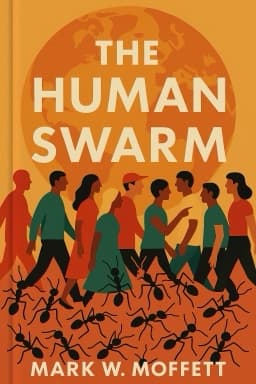
From Ants to Nations: How Invisible Markers Build Massive Societies
Discover the surprising biological parallels that explain how massive societies thrive without personal acquaintance.

Imagine an ant colony so vast it stretches over 50 square kilometers, containing billions of workers moving in perfect harmony. Unlike mammals that rely on individual recognition, these ants identify colony members through shared chemical scents coating their bodies. This ingenious system allows them to form supercolonies—anonymous societies where no one knows everyone personally, yet social cohesion remains unbroken.
Humans share a similar ability. While our cognitive limits restrict us to about 150 close relationships, we have developed language, clothing, rituals, and other cultural markers that signal membership to strangers. These markers function like chemical scents on ants, enabling societies to grow to millions and even billions without personal acquaintance.
The evolutionary roots of these markers trace back to primate calls, such as the pant-hoot, which served as early group identifiers. Over time, humans expanded this symbolic repertoire, creating complex languages and cultural rituals that define who belongs and who does not. This capacity for anonymous identification underpins the rise of cities, nations, and global communities.
However, the system is delicate. Just as ants may attack intruders with unfamiliar scents, humans can react with suspicion or hostility to outsiders lacking familiar markers. This dynamic explains much about intergroup conflict and the persistence of identity boundaries.
Understanding how invisible markers build massive societies illuminates the biological and cultural foundations of human social life, offering insights into cooperation, conflict, and identity in our interconnected world.
Want to explore more insights from this book?
Read the full book summary