
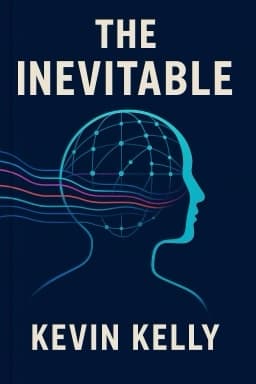
Why Kevin Kelly’s 'The Inevitable' Is Your Ultimate Guide to the Future of Technology
Discover the 12 unstoppable technological forces shaping our lives and why embracing them is the key to thriving tomorrow.

In a world where technology seems to change at lightning speed, Kevin Kelly’s 'The Inevitable' stands out as a beacon of clarity and optimism. This seminal work lays out 12 technological trends that are already underway and will continue to unfold, shaping the fabric of our daily lives. What makes Kelly’s vision compelling is his perspective that these changes are not abrupt revolutions but gradual, inevitable evolutions — a continuous process he calls “becoming.”
One of the foundational ideas in the book is the concept of 'Becoming.' Technology is never finished; it is always in flux, requiring constant upgrades and user adaptation. Think about your smartphone: it is never the same device you bought a year ago. Software updates, new apps, and changing interfaces keep it in a state of perpetual newness. This state of constant evolution means that mastery is fleeting, and lifelong learning becomes essential.
The second force, 'Cognifying,' describes the infusion of artificial intelligence into everyday objects. Rather than isolated supercomputers, AI will be embedded everywhere — in cameras, clothes, cars, and homes — creating a planetary brain that learns and adapts. This distributed intelligence will augment human capabilities and create new forms of collaboration between people and machines.
Kelly highlights the role of GPUs and big data as critical accelerators of this AI revolution, enabling machines to learn faster and perform tasks once thought uniquely human. The future is not about AI replacing humans but about humans partnering with smart machines to amplify creativity and problem-solving.
Another key trend is the unstoppable flow of digital information, which Kelly calls 'Flowing.' Unlike physical goods, digital data can be copied endlessly at near-zero cost, creating a superconductor of information. This abundance shifts economic value from copies to generative qualities like trust, immediacy, and personalization. Streaming music services, live events, and tailored content exemplify this shift, where access and experience outweigh ownership.
As screens multiply around us, becoming the primary medium of culture, they reshape how we consume information and connect socially. Kelly calls us 'People of the Screen,' living in a world where dynamic pixels replace printed pages, favoring interactivity and immediacy over permanence.
Accessing replaces owning as the dominant economic model. From ride-sharing to cloud computing, platforms enable flexible, on-demand use of resources, reducing waste and increasing convenience. This platform economy fosters collaborative consumption and challenges traditional property norms.
Kelly also explores the power of sharing and remixing, highlighting how user-generated content and open APIs fuel a collaborative renaissance. Creativity becomes a collective process, breaking down barriers between creators and consumers.
In the face of overwhelming information, filtering and interaction become essential. Sophisticated algorithms curate personalized streams, while touch, voice, and gesture interfaces deepen engagement.
Finally, pervasive tracking and the art of questioning guide us toward greater self-awareness and collective wisdom. Wearable devices and sensors offer real-time feedback, empowering healthier choices, while the ability to ask meaningful questions drives innovation and understanding.
In sum, 'The Inevitable' challenges us to embrace a future of continuous becoming, where technology and humanity evolve together. It is a hopeful, practical guide for anyone seeking to navigate the accelerating currents of change with confidence and curiosity.
Whether you are a technologist, entrepreneur, or curious reader, Kevin Kelly’s insights provide a rich framework to understand and thrive in the digital age.
For deeper exploration, check out these insightful resources that influenced this summary and analysis: Blinkist's summary of 'The Inevitable,' a detailed review on Humane Future of Work, and an in-depth Medium article exploring Kelly’s 12 forces. 1 2 3
Want to explore more insights from this book?
Read the full book summary