
Why You’re Wrong About Animal Instincts: The Science Behind Their Emotions and Consciousness
New research reveals how animals’ unconscious brain activity shapes emotions and decisions, debunking myths about instinct.

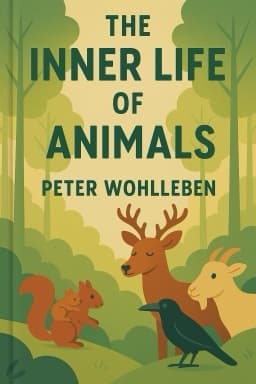
For too long, animals have been dismissed as creatures driven solely by instinct, lacking the emotional depth and conscious decision-making that humans pride themselves on. However, recent scientific discoveries and Peter Wohlleben’s compelling observations reveal a more nuanced reality: animals possess rich inner lives shaped by unconscious brain activity that governs their emotions and behaviors.
Magnetic resonance imaging (MRI) studies have shown that brain activity predicting a decision occurs seconds before a person becomes consciously aware of it. This finding extends to animals, suggesting that unconscious processes initiate many actions. Emotions such as fear, joy, and pain are linked to the limbic system, an ancient brain structure shared across species. This system allows rapid, automatic responses essential for survival.
For example, when a squirrel senses danger, it instinctively pulls its babies around its neck and runs, a behavior driven by unconscious emotional processing. Similarly, gray squirrels engage in deceptive tactics by digging empty caches to mislead competitors, indicating strategic thinking rather than mere reflex. Great tits emit false alarm calls to protect food sources, demonstrating social manipulation and cognitive complexity.
These behaviors show that instinct is not a simplistic or inferior form of emotion but a fundamental aspect of animal cognition. Animals share with humans a spectrum of awareness that blends unconscious emotional responses with learned behaviors and, in some cases, conscious choices.
Understanding this interplay challenges the traditional hierarchy that places human consciousness above animal experience. Instead, it invites us to appreciate the emotional and cognitive richness present in the animal kingdom, fostering empathy and respect.
By embracing these insights, we can better understand animal behavior, improve welfare standards, and cultivate a deeper connection with the natural world.
Sources: 5 Minute Book Summary, Bookey, Four Minute Books, Blinkist 1 2 3 4
Want to explore more insights from this book?
Read the full book summary