
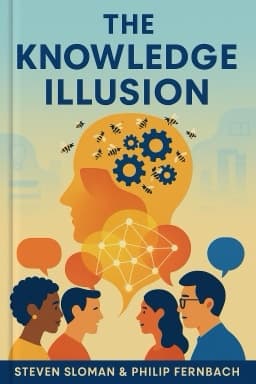
The Knowledge Illusion: Why You’re Not as Smart as You Think (But That’s a Good Thing!)
Discover why your brain’s limits are your greatest strength—and how to thrive in a world of shared wisdom.

Imagine being asked to explain how a zipper works. Most people, when first asked, feel confident—they’ve zipped up a jacket countless times. But as soon as they try to describe the mechanism, their confidence evaporates. This is the ‘illusion of explanatory depth,’ and it’s the opening gambit of Steven Sloman and Philip Fernbach’s eye-opening book, The Knowledge Illusion: Why We Never Think Alone 1 . The authors reveal that most of what we think we know is actually knowledge we borrow from others. Our brains are not designed to store encyclopedic detail; instead, we’re wired to collaborate, to rely on the expertise of our community, and to use the world itself as a kind of external memory.
This illusion isn’t a flaw. On the contrary, it’s what allows us to live in complex societies, build airplanes, and create the Internet. No single person understands every detail of a smartphone or a city’s plumbing. Instead, we specialize, trust, and pool our knowledge. This distributed intelligence is our superpower—but it also means we must be humble about our individual limitations. Overconfidence leads to mistakes in politics, business, and daily life. The antidote? Humility, curiosity, and the willingness to ask questions and seek help 4 .
Sloman and Fernbach show that even our memories are less like hard drives and more like ‘pointers’—links to information stored elsewhere, be it in books, tools, or other people’s minds. The rise of the Internet has made this even more apparent. We now have access to more information than ever before, but this can make us overestimate our own knowledge. Studies show that people who frequently use search engines often blur the line between what they know and what they can look up, leading to a new kind of digital overconfidence 1 .
So how do we become wiser? The authors suggest several habits: embrace collaborative learning, value diverse perspectives, and reflect on your own knowledge gaps. In education, this means encouraging group discussion and problem-solving, not just rote memorization. In business and politics, it means seeking out dissenting voices and being open to changing your mind. The most resilient communities are those that foster humility and curiosity, not just expertise 2 .
In the end, The Knowledge Illusion is a call to embrace our shared ignorance and turn it into a source of strength. The joy of learning comes not from knowing everything, but from discovering together. Next time you find yourself certain about a topic, pause and ask: could I explain this to someone else? If not, you’re in good company—and you’re ready to learn.
Want to explore more insights from this book?
Read the full book summary