
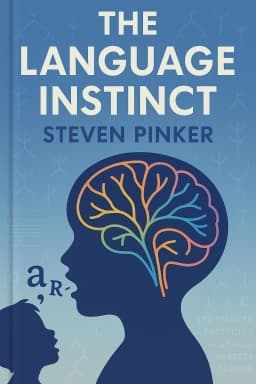
Is Language the Real Superpower? What Steven Pinker Reveals About Our Hidden Instinct
Unlocking the Mysteries of Human Speech and the Mind

Superheroes are everywhere in pop culture, but what if the most powerful ability isn’t flying or invisibility—it’s something you do every time you speak? Steven Pinker’s ‘The Language Instinct’ makes a compelling case that the real superpower is language itself. This isn’t just a communication tool; it’s the secret code that built civilization, art, and science.
The Evolutionary Leap
Pinker traces the roots of language back to our earliest ancestors. Unlike any other animal, humans are born ready to acquire language. Chimpanzees and dolphins can learn a few signs or sounds, but only humans invent grammar, tell stories, and create poetry. The genetic blueprint for language—universal grammar—evolved to give us a unique edge in survival and cooperation.
The Child Prodigies
Children are the true superheroes of language. In every culture, they master complex grammar by age five, without formal lessons. Pinker describes how even children exposed to broken or incomplete language invent new rules, creating fully expressive systems from scratch. The mind’s language module is most active in early childhood, making this window crucial for lifelong fluency.
The Brain’s Secret Language Zones
Modern neuroscience supports Pinker’s claims. Brain scans reveal specialized regions—like Broca’s and Wernicke’s areas—dedicated to language processing. Damage to these zones can erase grammar or comprehension, while leaving other abilities intact. This modularity shows that language is not just learned, but built into our neural circuits.
From Pidgin to Poetry
One of Pinker’s most dramatic stories is how children transform pidgins—simple, makeshift languages—into creoles with full grammar in a single generation. This linguistic creativity is a testament to the instinctive force of language, proving that children are not passive imitators, but inventors.
Language Diversity: A Living Tree
There are over 7,000 languages on Earth, each a branch on the tree of human history. Pinker shows that language change is constant—vocabulary, pronunciation, and grammar shift over time, creating new dialects and tongues. This diversity is a sign of vitality, not decay.
Conclusion: The Ultimate Adaptation
Language is the superpower that lets us cooperate, dream, and build worlds together. Pinker’s ‘The Language Instinct’ reveals how this gift is woven into our DNA, shaping not just how we speak, but how we think and connect. Next time you use a metaphor or tell a story, remember: you’re wielding the greatest power evolution ever gave.
Want to explore more insights from this book?
Read the full book summary