
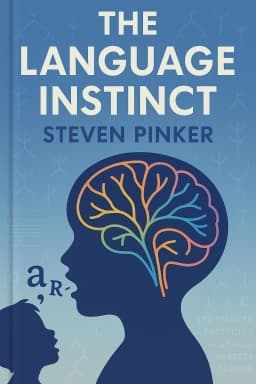
Why Language Is Hardwired: 7 Shocking Truths from Steven Pinker’s ‘The Language Instinct’
Discover the Hidden Instinct That Makes Us Human

Imagine waking up one day to discover that everything you’ve been told about language is wrong. That grammar isn’t a tedious set of rules, but a miraculous instinct. That every child, regardless of culture, is born with a hidden blueprint for speech. Steven Pinker’s ‘The Language Instinct’ is a revelation—a book that rips the curtain away from language and shows us the astonishing machinery underneath.
1. Language Is Not Taught—It’s Born
Most of us assume we learn language the way we learn math or history: by imitation and instruction. Pinker demolishes this myth. Children raised in environments where adults speak only crude pidgins spontaneously invent full-fledged creole languages, complete with grammar and syntax. Even deaf children, given only basic signs, create complex sign languages. The drive to create language is as instinctive as walking.
2. There Are No Primitive Languages
Think some languages are ‘simpler’ than others? Think again. Every language, from English to Pirahã, is equally complex and expressive. No human society has ever been discovered without a rich, rule-governed language. The myth of ‘primitive’ tongues is rooted in colonial prejudice, not science.
3. The Brain Has a Language Module
Language isn’t scattered randomly in the brain. Damage to specific areas (like Broca’s or Wernicke’s) can wipe out grammar or meaning, while leaving other intelligence untouched. Genetic disorders like SLI (Specific Language Impairment) and Williams syndrome show that language ability can be inherited—and can be selectively impaired, separate from general intelligence.
4. The Myth of Hundreds of Eskimo Words for Snow
Perhaps the most famous myth in linguistics is that Eskimos have hundreds of words for snow. Pinker traces this idea back to a chain of exaggerations and misunderstandings. In reality, Eskimo languages have about as many snow words as English. The real story is how language adapts to environment—not that it creates new realities from nothing.
5. Babies Are Language Geniuses
Children don’t just copy adult speech. They correct errors, invent new words, and regularize irregularities. The so-called ‘critical period’ for language learning means that if children miss early exposure, they may never become fluent—no matter how hard they try later. The window for effortless mastery is brief and precious.
6. Thought Exists Beyond Language
Pinker argues that we think in ‘mentalese’—a language of thought that predates words. Babies, animals, and even adults with aphasia can reason, plan, and imagine without words. Language is the dress of thought, not its skeleton.
7. Grammar Is Simpler Than You Think—And More Powerful
The secret to language’s infinite creativity is recursion: simple rules that can be applied over and over. With recursion, a child can nest clause within clause, creating sentences of unlimited length and complexity. This is the engine that drives every conversation, story, and poem.
Conclusion: Language as a Human Miracle
‘The Language Instinct’ invites us to see language not as a burden, but as a birthright—a miraculous gift coded into our DNA. It’s a story of creativity, resilience, and the deep connections that bind us all. Whether you’re a linguist, a parent, or just someone who loves words, Pinker’s discoveries will change the way you see yourself and the world.
Ready to challenge your assumptions? Dive into the science, and see why language is the heartbeat of humanity.
Want to explore more insights from this book?
Read the full book summary