
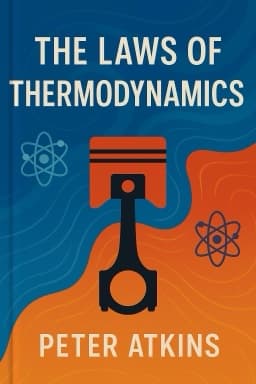
Unlocking the Secrets of Thermodynamics: How Heat, Energy, and Entropy Shape Our World
A Deep Dive into the Invisible Forces Governing Energy and Matter

Thermodynamics is the silent architect behind the behavior of energy and matter in our universe. From the warmth you feel on a sunny day to the complex machinery powering life itself, its laws govern the invisible dance of atoms and energy. Let’s embark on a journey through the fundamental laws that reveal how temperature, energy, and entropy shape everything around us.
The Zeroth Law: Defining Temperature Through Equilibrium
Imagine placing two metal blocks side by side. If after touching, their temperatures stabilize and no heat flows between them, they are said to be in thermal equilibrium. This simple observation is the essence of the zeroth law of thermodynamics. It tells us that temperature is a universal property, allowing us to measure it consistently across different systems. This law, though named last, is foundational because it enables the use of thermometers and the establishment of temperature scales. At the microscopic level, temperature reflects how molecules distribute themselves among energy states. As temperature rises, more molecules occupy higher energy levels, a distribution described by the Boltzmann distribution. This molecular perspective links the abstract notion of temperature to the tangible motions of atoms and molecules.
The First Law: Energy Conservation in Work and Heat
Energy cannot be created or destroyed, only transformed. This fundamental truth is enshrined in the first law of thermodynamics. Energy enters or leaves a system by doing work or transferring heat. Work is ordered energy transfer, like lifting a weight or compressing a spring, while heat is disordered energy transfer due to temperature differences. Inside a system, energy is stored as internal energy, a state function dependent only on the system’s current state, not the path taken to reach it. For example, stirring water in an insulated container raises its temperature equivalently whether done mechanically or by electrical heating, illustrating path independence. The concept of reversibility emerges here — reversible processes yield the maximum possible work, a guiding principle for efficiency.
The Second Law: Entropy and the Direction of Time
While energy is conserved, not all energy is equally useful. The second law introduces entropy, a measure of disorder and energy quality. It states that the total entropy of the universe increases in spontaneous processes, giving time its arrow. Consider a steam engine: it cannot convert all heat from a hot source into work because some energy must be discarded to a cold sink, increasing entropy. This sets fundamental efficiency limits. On a molecular level, entropy quantifies the number of microscopic configurations consistent with a system’s state. For example, when a gas expands into a vacuum, its entropy increases as molecules have more possible positions. This statistical interpretation connects microscopic uncertainty to macroscopic irreversibility.
Free Energy: The Real Workhorse of Thermodynamics
Not all energy in a system can do work; free energy refines this concept by subtracting the energy tied up in entropy. Helmholtz free energy (A = U - TS) applies at constant volume and temperature, while Gibbs free energy (G = H - TS) is crucial at constant pressure and temperature, especially in chemistry and biology. A negative change in Gibbs free energy indicates a spontaneous process. Biological systems rely on Gibbs free energy to drive essential reactions, such as ATP hydrolysis powering protein synthesis. Free energy also governs phase transitions and chemical equilibria, determining the conditions under which substances change state or react.
The Third Law and Absolute Zero: The Ultimate Limits
The third law of thermodynamics states that the entropy of a perfect crystal approaches zero as temperature nears absolute zero. However, reaching absolute zero is impossible because removing the last traces of energy requires infinite work. Some solids exhibit residual entropy at zero kelvin due to degenerate ground states, like the disordered hydrogen orientations in ice. Techniques such as adiabatic demagnetization allow scientists to approach but never reach absolute zero, revealing quantum phenomena in ultra-cold regimes.
Beyond Zero: The Curious Case of Negative Temperatures
In a surprising twist, certain systems can exhibit negative absolute temperatures, which are paradoxically hotter than any positive temperature. These occur in specialized systems with bounded energy levels, such as spin ensembles and lasers, where population inversion creates more molecules in higher energy states than lower ones. Negative temperature states are non-equilibrium and transient but provide profound insights into thermodynamics and quantum mechanics. Heat flows from negative to positive temperature systems, confirming their extreme 'hotness.'
Conclusion: The Invisible Laws That Shape Reality
Thermodynamics reveals the deep and beautiful order underlying all physical change, from the warmth of a cup of tea to the burning heart of stars. Its laws govern energy flow, the direction of time, and the limits of what is possible. Understanding these principles enriches our appreciation of the natural world and empowers innovations in energy, chemistry, biology, and technology. As we continue exploring, the strange and wondrous realms of thermodynamics invite us to marvel at the universe’s elegant complexity.
For further reading, consider exploring foundational texts and modern interpretations that deepen these insights and connect them to cutting-edge research in physics and beyond.
Sources: The Laws of Thermodynamics: A Very Short Introduction (Goodreads), The Laws of Thermodynamics: A Very Short Introduction (Amazon), Thermodynamics-Everyone (C&EN)
Want to explore more insights from this book?
Read the full book summary