
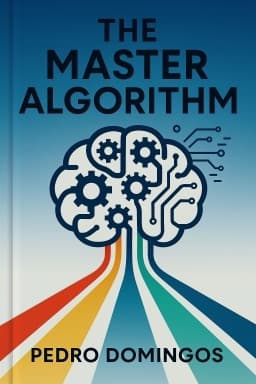
Inside the Five Tribes of Machine Learning: Which One Will Rule?
Discover the Rival Philosophies Competing to Build the Ultimate Learning Machine

Discover the Rival Philosophies Competing to Build the Ultimate Learning Machine
Machine learning is not a single discipline but a vibrant tapestry woven from five distinct traditions, or 'tribes,' each with its own heroes, methods, and dreams. In 'The Master Algorithm', Pedro Domingos traces the lineage of these tribes, showing how their rival philosophies have shaped the evolution of artificial intelligence. The Symbolists, heirs to the tradition of logic and mathematics, build systems that reason with rules and symbols. Their algorithms excel at tasks like theorem proving and expert systems. Connectionists, inspired by the brain, design artificial neural networks that learn from vast amounts of data—powering today’s advances in speech and image recognition. Evolutionaries see learning as a process of adaptation, using algorithms modeled on genetic evolution to solve complex optimization problems. Bayesians treat learning as a matter of probability, constantly updating beliefs as new evidence arrives. Analogizers, finally, rely on the power of similarity, using methods like support vector machines to classify and predict by comparison.
Each tribe has scored major victories. Connectionist neural networks now outperform humans in tasks like image classification and game playing. Symbolist rule learners power many expert systems in medicine and finance. Evolutionaries design everything from investment portfolios to new drugs. Bayesians underpin spam filters and medical diagnostics, while Analogizers enable recommendation engines and pattern recognition. Yet, each approach also has limits, and the quest for the master algorithm is a search for their synthesis.
Which tribe will rule? Domingos suggests that the future belongs not to any single approach, but to their creative fusion. As machine learning continues to evolve, the boundaries between tribes blur, and the dream of a universal learner comes ever closer. Understanding these tribes is not just for insiders—it’s a key to understanding the future of intelligence itself.
Cited sources: 'The Master Algorithm', reviews from Towards Data Science and Eleodor.com, and recent AI research summaries 2 3
Want to explore more insights from this book?
Read the full book summary