
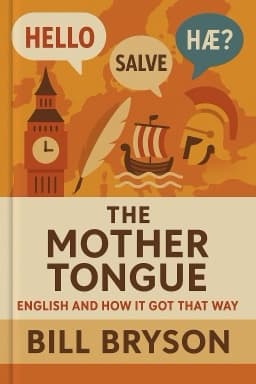
7 Mind-Blowing Secrets About the English Language from Bill Bryson’s 'The Mother Tongue'
Discover the Hidden Stories, Wild Eccentricities, and Surprising Truths Behind the World’s Most Popular Language

Discover the Hidden Stories, Wild Eccentricities, and Surprising Truths Behind the World’s Most Popular Language
English is everywhere. It’s the language of global business, science, and pop culture—a passport to opportunity and connection. But how did it get this way? Bill Bryson’s 'The Mother Tongue' is the ultimate guidebook for anyone who’s ever wondered why English is so weird, so wonderful, and so powerful. Here are seven jaw-dropping secrets from the book that will change the way you think about the words you use every day.
1. English Wasn’t Always a Global Superstar
Imagine a time when English was considered a peasant’s language, unworthy of courts or scholarship. That was the case for centuries. The language we now associate with Shakespeare and the United Nations started as a jumble of dialects spoken by tribes on a rainy island. Its rise to dominance is a story of survival, adaptability, and luck, shaped by invasions, trade, and technology. Today, English is the language of aviation, science, and the internet, with more learners in China than there are people in the United States.
2. The Origins of Language Are Still a Mystery
How did language begin? Bryson takes us back to prehistoric caves, where humans first started telling stories around the fire. We don’t know exactly when or how the first words were spoken—estimates range from 20,000 to 200,000 years ago. What we do know is that humans are uniquely equipped for speech, thanks to our descended larynx and innate ability to babble and invent grammar as children. Some languages, like Basque, remain mysterious relics of ancient times, unrelated to any other tongue.
3. English Is Just One Leaf on a Vast Language Tree
English belongs to the Indo-European family, sharing roots with languages as diverse as Hindi, Russian, and French. Words for family, numbers, and nature often sound similar across these languages, revealing ancient connections. Some languages, like Lithuanian, preserve features so old that they can communicate with Sanskrit speakers. English’s journey has been shaped by migrations, invasions, and the slow drift of dialects—a living record of human history.
4. Invasions Made English Simpler and Stronger
The English language is a survivor. Waves of Romans, Saxons, Vikings, and Normans brought new words and ideas, turning English into a patchwork of influences. The Normans alone added over 10,000 French words, especially in law, government, and cuisine. The Vikings gave us everyday pronouns like 'they' and 'them.' Through this chaos, English lost many of its complex endings and gendered nouns, making it surprisingly simple compared to other European languages.
5. English Loves to Invent and Borrow Words
English is a magpie language, always on the lookout for shiny new words. It borrows from everywhere: 'shampoo' from Hindi, 'ketchup' from Chinese, 'slogan' from Gaelic. It also creates words out of necessity or even by accident—like 'dord,' a dictionary ghost word. Some words, like 'sanction' or 'cleave,' have opposite meanings, making English both playful and perplexing.
6. Spelling and Pronunciation: A Beautiful Mess
Why is English spelling so chaotic? Blame the Great Vowel Shift, the printing press, and centuries of borrowing. The word 'ough' alone has at least eight pronunciations. Attempts at spelling reform have failed, leaving us with a language that is both a puzzle and a playground.
7. Language Is Healing, Uniting, and Always Evolving
At its heart, language is about connection. Bryson shows how English, for all its quirks, brings people together, inspires creativity, and even boosts brain health. Accents and dialects are now celebrated as symbols of identity and heritage. The joy of language lies in its resilience and its power to surprise, comfort, and unite us.
Conclusion: The Adventure of English Is Far from Over
'The Mother Tongue' is more than a history book—it’s a celebration of the weird, wonderful world of English. Whether you’re a student, a teacher, or a lifelong word nerd, Bryson’s insights will leave you smiling, questioning, and marveling at the language you thought you knew. Dive in, and let the adventure begin. For more fun facts and reviews, check out summaries and discussions on Goodreads, SoBrief, and expert blogs. 1 2 3
Want to explore more insights from this book?
Read the full book summary