
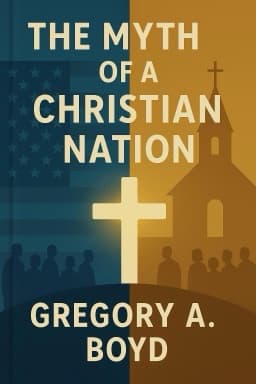
How Political Idolatry Is Silencing the Church—and What We Can Do About It
Escaping the Trap of Power and Recovering the Prophetic Voice

Escaping the Trap of Power and Recovering the Prophetic Voice
Political idolatry is a subtle but devastating threat to the church’s health and mission. Gregory Boyd’s The Myth of a Christian Nation exposes how the church’s pursuit of political power leads to division, mission drift, and the loss of its prophetic voice. When believers equate their faith with a particular party or candidate, they risk making an idol of their ideology, putting it above the radical call of Jesus.
The consequences are everywhere: congregations split along party lines, sermons that sound like campaign speeches, and a growing cynicism among outsiders. The church’s unique calling—to love enemies, speak truth to power, and serve the least—is drowned out by the noise of culture wars. Boyd draws on stories of churches pressured to endorse candidates, only to see unity and mission sacrificed on the altar of political gain.
But there is a way out. Boyd calls the church to reclaim its prophetic voice—not by withdrawing from society, but by refusing to be co-opted by any political agenda. This means speaking truth even when it’s unpopular, loving those on the margins, and serving without expectation of reward. The church’s greatest influence comes not from power, but from faithfulness to the cross.
Practical steps include fostering honest dialogue, prioritizing unity over uniformity, and focusing on the core teachings of Jesus. When the church puts love first, it becomes a beacon of hope in a divided world, able to challenge injustice without becoming captive to any ideology.
In the end, the church’s prophetic power is found not in the halls of government, but in the daily acts of love that point to a different kind of kingdom.
Sources:
1
2
3
Want to explore more insights from this book?
Read the full book summary