
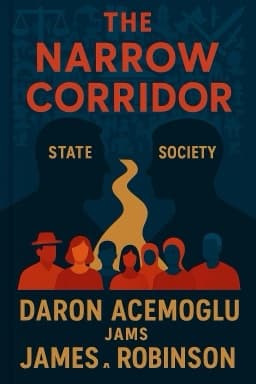
Why 'The Narrow Corridor' Is the Ultimate Guide to Understanding Liberty’s Fragile Dance
Discover the delicate balance that shapes freedom across societies and why it matters now more than ever.

Liberty is often taken for granted in modern societies, yet its roots are complex, fragile, and deeply contested. In their seminal work, The Narrow Corridor, economists and political scientists Daron Acemoglu and James Robinson unravel the intricate relationship between state power and societal control, revealing that freedom is not a gift but a continuous, precarious balance.
This book challenges conventional wisdom by emphasizing that neither state strength nor societal mobilization alone guarantees freedom. Instead, liberty flourishes in a narrow corridor where these forces run in tandem—each pushing the other forward in what the authors call the Red Queen effect, inspired by Lewis Carroll's metaphor of running just to stay in place.
The story begins with ancient history. The Epic of Gilgamesh illustrates the timeless problem of controlling power—a king whose unchecked strength threatens his people. This allegory sets the stage for understanding why liberty has been so rare throughout human history. Societies have oscillated between despotism, anarchy, and the elusive balance of liberty.
Acemoglu and Robinson introduce three types of Leviathans to describe states: the Absent Leviathan, which lacks capacity and leaves citizens vulnerable to violence; the Despotic Leviathan, powerful but unaccountable and repressive; and the Shackled Leviathan, where state power is balanced by societal control, enabling freedom and prosperity.
Economic consequences follow these political forms closely. Stateless societies suffer from high violence and insecurity, impeding commerce and innovation. Despotic states may foster growth but concentrate wealth and restrict opportunity. Shackled Leviathans provide the security and trust necessary for broad-based economic development.
The authors trace how Europe uniquely forged this balance through the 'European scissors'—a marriage of Roman legal bureaucracy and Germanic tribal political participation. This fusion created institutions like parliaments that restrained rulers and empowered citizens, widening the narrow corridor.
In contrast, China developed a strong, centralized state with limited societal input, resulting in a despotic Leviathan. India’s rigid caste system fragmented society, weakening state capacity and restricting liberty. These contrasting paths highlight that the road to freedom is neither uniform nor guaranteed.
The book also warns of the dangers when trust between state and society breaks down, leading to zero-sum struggles that erode liberty and destabilize institutions, as seen in the collapse of the Weimar Republic and the rise of populism worldwide.
Looking forward, Acemoglu and Robinson argue that liberty requires ongoing vigilance and adaptation to new challenges—digital surveillance, climate change, and global interdependence. Society must remain engaged to hold power accountable and defend freedoms.
In essence, 'The Narrow Corridor' is a masterful exploration of the fragile dance that sustains liberty, a call to recognize freedom’s complexity and to cherish the delicate balance that keeps it alive.
Want to explore more insights from this book?
Read the full book summary