
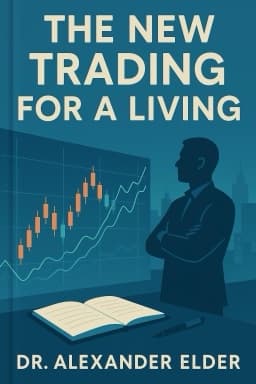
7 Powerful Lessons from 'Trading for a Living' That Will Transform Your Financial Future
Unlock the Mindset and Methods Behind Consistent Trading Success

If you’ve ever wondered why some traders seem to thrive while others burn out, Dr. Alexander Elder’s 'Trading for a Living' holds the answers. This legendary book is not just another technical manual—it’s a masterclass on the psychology, discipline, and systems that separate winners from losers in the financial markets. In this blog, we’ll dive deep into Elder’s most transformative lessons, blending insights from the book with wisdom from trading communities and contemporary research.
1. The Mind is the First Market
Every trade begins in the mind. Elder argues that self-awareness is the core of trading success. Before you ever analyze a chart or place a trade, you must confront your own motivations, fears, and goals. Are you trading for excitement, for ego, or for genuine financial independence? Elder’s background as a psychiatrist gives him a unique perspective: trading is a mirror that reflects our deepest emotional patterns. Journaling, self-reflection, and honest assessment are essential tools for uncovering these patterns and breaking free from self-sabotage.
2. Emotional Discipline: The Hidden Edge
Markets are unpredictable, but your reaction doesn’t have to be. Emotional discipline—knowing when to step back, when to let go of a losing trade, and when to resist the thrill of a winning streak—is the true edge. Elder explains that most traders lose money not because of bad analysis, but because of poor emotional control. He draws parallels between trading and addiction, showing how the highs and lows can become addictive. The solution? Create routines, keep detailed records, and develop the self-control to follow your plan even when emotions run high.
3. Risk Management: Your Financial Shield
Risk management isn’t just a safety net—it’s the foundation of trading. Elder’s famous '2% rule'—never risk more than 2% of your capital on any single trade—protects traders from catastrophic losses. He emphasizes that a 50% drawdown requires a 100% gain to recover, making capital preservation paramount. Stop-loss orders, position sizing, and strict loss limits are the keys to surviving the inevitable storms of the market.
4. The Power of Systems and Journals
Consistency beats brilliance in trading. Elder advocates for robust systems—like his famous Triple Screen System—that filter trades through multiple timeframes and criteria. But a system is only as good as your willingness to follow it. That’s where journaling comes in. By recording every trade, every emotion, and every mistake, you gain the self-awareness needed for continuous improvement. Your journal becomes your most honest mentor.
5. Reading the Crowd: Technical Analysis as Psychology
Every price movement is a vote by thousands of traders, each with their own hopes and fears. Elder teaches that technical analysis is less about numbers and more about understanding crowd psychology. Patterns, trends, support, and resistance are all footprints of collective emotion. By focusing on the essentials—open, high, low, close, and volume—you can cut through the noise and see the true story of the market.
6. Community and Continuous Learning
The best traders are lifelong learners. Elder encourages traders to seek out community—whether through online forums, study groups, or mentorship. Sharing ideas, discussing mistakes, and staying humble are the keys to adaptation in an ever-changing market. What worked yesterday may not work tomorrow, so curiosity and humility are your greatest assets.
7. Trading as a Journey of Growth
Ultimately, 'Trading for a Living' is about more than money. It’s about becoming the best version of yourself—disciplined, self-aware, and resilient. Every trade is a lesson, every loss an opportunity for growth. By integrating Elder’s lessons into your daily practice, you’ll not only become a better trader, but a wiser, more balanced person.
Ready to take your trading to the next level? Start with your mind, build your systems, and never stop learning. The market is your teacher, and every day is a new lesson.
Want to explore more insights from this book?
Read the full book summary