
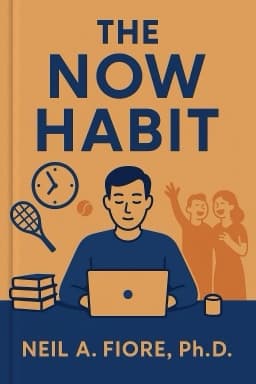
Beat Procrastination Now: The Ultimate Guide to Unlocking Your Productivity with 'The Now Habit'
Discover how to transform procrastination into productive power through proven psychological strategies.

Procrastination is often mislabeled as laziness or poor time management, but as Neil Fiore explains in The Now Habit, it is a complex emotional response primarily driven by anxiety and fear. Many procrastinators are highly motivated in other areas of life, which dispels the myth that procrastination is simply about lacking motivation. Instead, it serves as a coping mechanism to protect self-esteem from perceived threats like fear of failure, perfectionism, or resentment toward imposed tasks. Understanding this root cause is the first step toward change.
Transforming Your Inner Dialogue: From 'I Have To' to 'I Choose To'
One of the most powerful shifts in overcoming procrastination is changing how we talk to ourselves. Phrases like 'I have to' or 'I should' create an internal battle, fostering resistance and paralysis. By consciously replacing these with 'I choose to' statements, we align our mind and body toward cooperative action. This subtle linguistic change empowers us, fostering ownership and responsibility. Learning to say no assertively also protects our energy and reduces overwhelm.
The Vital Role of Guilt-Free Play in Productivity
Contrary to popular belief, play is not the enemy of productivity; it is its ally. Scheduling guilt-free leisure time restores energy, reduces resentment, and fuels creativity. Play activates the subconscious mind, enabling spontaneous insights and problem-solving. Peak performers understand this balance, prioritizing recreation alongside work to avoid burnout and maintain high performance.
Breaking Through Blocks: Practical Strategies
Overwhelm, fear of failure, and fear of incompletion are common psychological blocks that stall progress. Techniques like breaking tasks into manageable parts, using 'three-dimensional thinking' to spread effort over time, confronting worst-case scenarios with planning, and committing to persistent starting help dismantle these barriers. Even brief exposure to feared tasks with positive self-talk can reduce avoidance and build confidence.
Entering the Flow State: Work That Feels Effortless
Flow is a state of deep immersion where time seems to distort, self-consciousness fades, and creativity flourishes. Achieving flow requires a balance between challenge and skill, clear goals, and immediate feedback. Structuring work in focused blocks and embracing imperfection can help sustain this state, turning work into a source of joy and fulfillment.
Sustaining Momentum and Embracing Setbacks
Maintaining progress involves realistic goal setting, tracking accomplishments to build motivation, and viewing setbacks as normal, instructive parts of growth. Preparing mentally for obstacles fosters resilience, enabling us to adapt and persist rather than give up when challenges arise.
Supporting Procrastinators with Compassion and Boundaries
Procrastination impacts relationships as well. Nagging often backfires, increasing resistance. Instead, fostering autonomy, using empathetic communication, setting clear priorities, and celebrating progress encourages motivation. Balancing support with boundaries maintains healthy relationships and promotes productive habits.
Embracing the Now Habit: Your Path to Empowered Production
Procrastination is reversible with awareness, strategic effort, and self-compassion. Small starts build momentum and rewire habits, reducing fear and increasing confidence. By integrating these principles, you can transform from a procrastinator into an empowered producer, enjoying a balanced, fulfilling life of productivity and joy.
Start your journey today. Remember, the secret of getting ahead is getting started.
— Mark Twain
Sources: dansilvestre.com, shortform.com, readingraphics.com, blinkist.com 1 2 3 4
Want to explore more insights from this book?
Read the full book summary