
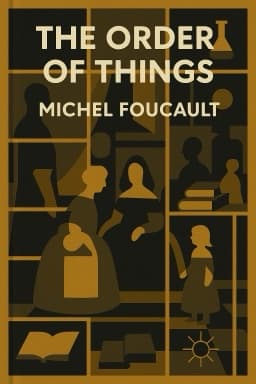
How 'The Order of Things' Reveals the Secret History of Man and Knowledge
An in-depth look at how Foucault uncovers the recent invention of man and the rise of human sciences shaping modern knowledge.

What if I told you that the concept of 'man' as the center of knowledge is less than two centuries old? Michel Foucault’s 'The Order of Things' unmasks this startling truth, revealing man as a recent invention in the grand narrative of epistemology.
Man’s emergence marks a profound shift: from knowledge structured by resemblance and symbolic orders to knowledge centered on the empirical and transcendental dimensions of human existence. This dual nature—what Foucault calls the empirico-transcendental doublet—forms the foundation of the human sciences.
The human sciences themselves are precarious, caught between mathematical formalization and the complexities of life, language, and labor. Their epistemology is unstable, continually contested and evolving.
Language, once a transparent natural sign, becomes a system of binary signs valued for discourse and representation. Literature reclaims the raw essence of language, challenging the dominance of signification.
Finally, Foucault redefines the subject not as the originator but as a product of discursive practices—rules that govern what can be said, thought, and accepted as knowledge.
This revelation reshapes how we understand knowledge, science, and the human condition, inviting us to reconsider the foundations of the human sciences and the role of discourse in shaping reality.
Explore more on this fascinating topic: