
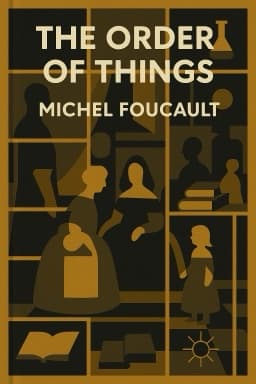
Unlocking the Mysteries of Knowledge: How 'The Order of Things' Changes Everything You Thought You Knew
Dive deep into Michel Foucault's groundbreaking exploration of how human knowledge evolved through ages, reshaping our understanding of science, language, and man.

Imagine stepping into a world where knowledge is not static but a living tapestry, woven from the threads of resemblance, signs, and symbolic marks. This was the Renaissance worldview, where every plant, animal, and stone bore 'signatures'—visible marks that revealed hidden truths. In this enchanted universe, understanding meant deciphering a vast, living text, where writing held primacy as the active principle of truth beyond transient speech.
As time marched forward, this rich symbolic order gave way to a new epistemic regime—the Classical age. Here, resemblance was critiqued and replaced by the rigorous distinction of identity and difference. Knowledge was no longer a sprawling network of infinite analogies but a structured order, governed by mathesis (calculable order) and taxinomia (classification). Signs were redefined as binary relations between signifier and signified, laying the foundation for modern linguistics and scientific inquiry.
Then emerged man—not just as a biological being but as the central figure of knowledge, embodying an empirico-transcendental doublet: both empirical and transcendental. This modern invention of man, less than two centuries old, introduced the analytic of finitude, recognizing the limits of body, language, and desire as conditions shaping knowledge.
Language itself underwent a transformation. Once a transparent natural sign linked by resemblance, it became a complex system of binary signs, valued primarily as discourse and representation. Literature later emerged as a counter-discourse reclaiming the raw essence of language beyond strict signification.
The rise of the human sciences marked a new precarious domain of knowledge, centered on man but distinct from natural sciences. Despite using mathematical tools, these sciences reflect a retreat from universal mathematical order, grappling with the complexities of life, language, and labor. Their epistemology is unstable, marked by internal tensions and external critiques.
Knowledge does not evolve gradually but through sudden, multifaceted revolutions. These shifts occur at different levels and speeds, shaped by complex social, intellectual, and material interactions rather than individual genius alone.
Finally, the role of the subject in knowledge is re-examined. Rather than being the origin of knowledge, the subject is an effect of discursive practices governed by implicit rules. Scientific discourse operates within these rules, defining what can be said, thought, and accepted, shifting focus from individual agency to structural conditions.
Foucault's 'The Order of Things' invites us to see knowledge as a dynamic, historically contingent practice shaped by complex orders and ruptures. It challenges us to rethink the foundations of science, language, and the human subject itself, offering a profound meditation on how we come to understand our world and ourselves.
For those ready to challenge their assumptions and explore the depths of epistemology, this journey offers both illumination and transformation.
References and further reading: