
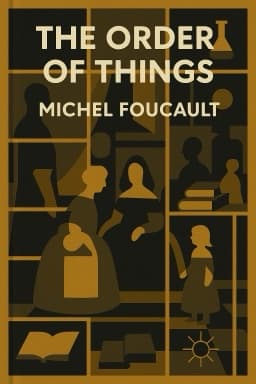
Why Michel Foucault’s 'The Order of Things' Is the Ultimate Mind-Bender You Need to Read
A provocative dive into Foucault’s revolutionary ideas that challenge everything you thought about knowledge, science, and the human subject.

Few books have shaken the intellectual world as profoundly as Michel Foucault’s 'The Order of Things.' It challenges the very foundations of knowledge, revealing how what we take for granted as 'truth' is contingent on historical episteme—systems of thought that change and rupture over time.
At the heart of Foucault’s analysis is the idea that knowledge is not a linear accumulation but a series of breaks and transformations. The Renaissance’s symbolic resemblance-based knowledge, with its infinite hermeneutic spirals, gave way to the Classical age’s ordered, binary sign systems. Here, knowledge became calculable, classified, and represented with precision.
Then came man, a recent invention who embodies both empirical existence and transcendental conditions. This duality introduces finitude—limits that shape how knowledge is possible. Language shifts from a natural sign to a complex system of discourse, with literature reasserting the raw essence of words.
The human sciences emerge as a precarious field, balancing mathematical tools with the complexity of life and culture. Scientific revolutions are sudden, multifaceted, and cannot be attributed to single causes, reflecting the dynamic nature of knowledge.
Finally, Foucault redefines the subject—not as the origin of knowledge but as an effect of discursive practices. Scientific discourse operates within implicit rules that govern what can be said, thought, and accepted, shifting focus from individual agency to structural conditions.
Reading 'The Order of Things' is a mind-bending journey that forces us to question the stability of knowledge, the nature of science, and the place of man in the epistemological order. It is essential reading for anyone interested in philosophy, critical theory, or the history of ideas.
For further insights, explore these resources: