
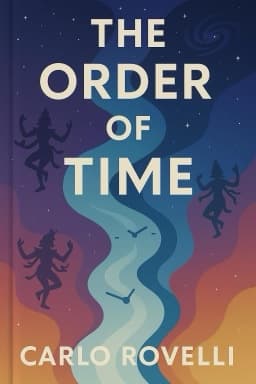
Is Time an Illusion? Revealing the Shocking Truth Behind Our Clock’s Ticking
Dive deep into the mind-bending revelations of Carlo Rovelli’s 'The Order of Time' and discover why your everyday sense of time might be completely misleading.

Dive deep into the mind-bending revelations of Carlo Rovelli’s 'The Order of Time' and discover why your everyday sense of time might be completely misleading.
Time is the backdrop of our lives, the steady rhythm by which we measure existence. Yet, modern physics reveals that this rhythm is not universal but a patchwork of local tempos. Imagine two friends—one living atop a mountain, another in the valley below. Their clocks, once synchronized, now disagree by fractions of a second due to gravity’s influence on time itself. This phenomenon, gravitational time dilation, demonstrates that time does not flow uniformly everywhere.
Einstein’s theory of relativity shattered the centuries-old Newtonian idea of absolute time. Instead, each clock measures its own 'proper time,' unique to its path through spacetime. This plurality of times means that the universe is not governed by a single ticking clock but by a chorus of rhythms intertwined with gravity and motion.
But time’s mystery deepens. The arrow of time—the sense that the past is fixed and the future open—does not arise from fundamental physical laws, which are time-symmetric. Instead, it emerges from the second law of thermodynamics: entropy increases, disorder grows, and heat flows irreversibly from hot to cold. Our experience of time’s direction is thus tied to the growth of entropy and our limited perspective.
Moreover, the idea of a universal 'now' dissolves under relativity. Events that appear simultaneous to one observer may not be for another moving differently. The present is a local bubble, defined by the observer’s frame and the speed of light’s limits. Spacetime diagrams reveal light cones that define past and future, but no absolute present slices through the cosmos.
Time is not an independent entity but a dynamic field intertwined with space and matter. Spacetime curves and stretches, influenced by mass and energy, causing clocks near massive bodies to slow down. This dynamic nature leads to fundamental limits on synchronizing clocks across distances.
At the quantum scale, time becomes granular and relational. Below the Planck time (~10^-44 seconds), the smooth flow of time breaks down into discrete quanta. Spacetime itself fluctuates in superpositions of geometries, a quantum foam where events and properties become definite only through interactions.
Rovelli’s vision reframes reality as a network of events and processes rather than static things. Change is fundamental, and our language struggles to capture this complex temporal web. Presentism and eternalism, common philosophical stances about time, fail to reconcile with relativity and quantum mechanics.
Ultimately, time emerges from entropy, perspective, and memory. Our psychological experience of past, present, and future is shaped by memory and anticipation within consciousness. Time is as much a feature of ourselves as of the cosmos.
This journey through 'The Order of Time' invites us to rethink everything we thought we knew about time, revealing a universe far stranger and more beautiful than our everyday experience suggests.
For those fascinated by the nature of reality and time, this is a must-read exploration that blends science, philosophy, and poetic insight into one compelling narrative.
Sources: The Guardian review of 'The Order of Time' 1 , Kirkus Reviews 2 , personal synthesis of scientific literature.
Want to explore more insights from this book?
Read the full book summary