
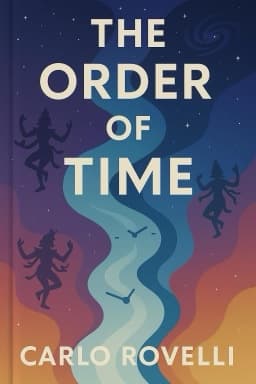
Why Your Brain’s Sense of Time Is Totally Wrong — And What Physics Says Instead
Uncover how our brain constructs the illusion of flowing time and how modern physics challenges this deeply held perception.

Uncover how our brain constructs the illusion of flowing time and how modern physics challenges this deeply held perception.
The steady ticking of clocks and the rhythm of days give us a comforting sense of time’s flow. Yet, this flow is not something the universe mandates but something our brains construct. Memory and anticipation create the psychological arrow of time, linking past experiences with future expectations.
Physicists like Carlo Rovelli explain that at the fundamental level, the universe’s laws do not prefer a direction of time; they are symmetric. The arrow of time arises from entropy’s increase — the growing disorder in systems — and our incomplete knowledge. This entropy gradient is what gives rise to the flow we perceive.
Relativity further complicates the picture by showing that simultaneity is relative. Different observers experience different presents, meaning there is no universal 'now.' This challenges the brain’s assumption of a shared, flowing time and forces a reconsideration of how consciousness relates to physics.
Quantum mechanics adds another layer of complexity. At the smallest scales, time is granular and probabilistic, with spacetime itself fluctuating. Events become definite only through interactions, emphasizing relational existence rather than absolute states.
Our brains, evolved to navigate a macroscopic world, interpret this complex reality through simplified narratives of past, present, and future. This discrepancy between physical time and psychological time is a source of profound philosophical and scientific inquiry.
Understanding that time is an emergent property shaped by entropy, perspective, and memory not only deepens our grasp of physics but also enriches our appreciation of consciousness and existence.
In this light, the mystery of time becomes a mirror reflecting the profound connection between the cosmos and our inner life.
Sources: The Order of Time reviews and neuroscience articles 1 3 , Techietonics book review 4 .
Want to explore more insights from this book?
Read the full book summary