
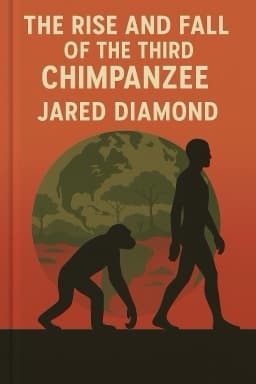
Why Are We the Third Chimpanzee? Unveiling the Surprising Truth About Human Evolution
Discover how tiny genetic differences made us who we are today — and why understanding our roots can change everything.

Have you ever wondered what truly separates humans from our closest relatives, the chimpanzees? It might surprise you to learn that genetically, we are not so different — in fact, humans share approximately 98.4% of their DNA with chimpanzees, making us effectively a third species of chimpanzee. This is the provocative premise of Jared Diamond's groundbreaking book, The Third Chimpanzee. But what does that 1.6% difference actually mean? And how did it transform us from forest-dwelling primates into the architects of civilization?
Diamond introduces us to the astonishing closeness of our genetic makeup with chimps and bonobos, two chimpanzee species that differ from each other by only about 0.7%. Yet, despite these minuscule differences, humans developed language, art, and culture, while chimpanzees remained in their natural habitats. This illustrates the power of small genetic changes to drive massive evolutionary leaps.
One of the most compelling examples is the Great Leap Forward about 40,000 years ago, when humans suddenly began creating cave paintings, musical instruments, and sophisticated tools. This cultural explosion marks the dawn of behavioral modernity and sets us apart from other species with larger brains but less cultural complexity, such as Neanderthals.
Diamond also explores unique human life-cycle traits, like our unusually long childhoods, menopause, and biparental care. These traits underpin our complex social structures and enable the transmission of culture and knowledge across generations. For example, the extended period of childhood dependency allows for learning the intricate skills required to survive and thrive in diverse environments.
When it comes to sexuality, humans display bizarre behaviors compared to other animals—a concealed ovulation, private copulation, and sexual anatomy that reflects evolutionary pressures related to mating systems. These traits foster pair bonding and paternal investment, which are critical for raising our helpless young.
Yet, Diamond doesn’t shy away from humanity’s darker aspects. Our species exhibits xenophobic violence and has perpetrated genocide on a scale unmatched in nature. While intergroup violence has evolutionary roots in animal behavior, the technological amplification and social complexity of humans make our conflicts devastating.
Environmental impact is another critical theme. From the collapse of Easter Island society due to deforestation to the global extinction of megafauna following human migration, our species has repeatedly damaged ecosystems. This environmental mismanagement continues today, exacerbated by rapid population growth and technological power.
However, Diamond ends on a hopeful note, emphasizing our capacity for self-awareness, cultural evolution, and cooperation. Modern societies have reduced violent deaths, and conservation efforts have saved endangered species. Education and political will are vital for shaping a sustainable future.
This book is a profound meditation on what it means to be human, blending biology, anthropology, history, and ethics into a compelling narrative. Understanding our shared ancestry with chimps challenges us to embrace responsibility for ourselves, each other, and the planet.
For anyone curious about human origins, behavior, and future, The Third Chimpanzee is a must-read that reshapes how we see ourselves in the natural world.
Ready to dive deeper? Let’s explore the evolutionary mysteries and lessons from our closest relatives and the journey that made us uniquely human.
Want to explore more insights from this book?
Read the full book summary