
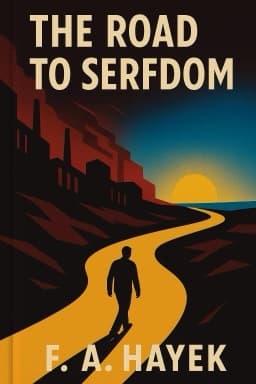
Why 'The Road to Serfdom' Is More Relevant Today Than Ever Before
Exploring how Hayek’s warnings resonate in the 21st century political landscape.

In an age marked by unprecedented government interventions—from economic stimulus packages to public health mandates—the lessons of Friedrich Hayek’s The Road to Serfdom resonate with renewed urgency. Written during a time of global conflict and ideological turmoil, Hayek’s book warned that the road to centralized control is paved with good intentions but leads inevitably to the erosion of freedom.
Today, as nations grapple with crises like pandemics, climate change, and economic inequality, the temptation to rely on expansive government planning grows stronger. Hayek’s insight that central planning requires coercion remains a critical caution. When states impose uniform solutions, they risk stifling the diversity of individual choices and initiatives that fuel innovation and progress.
Moreover, the psychological effects Hayek described—dependency replacing initiative, citizens becoming passive recipients rather than active participants—are visible in many modern welfare states. The challenge is to design policies that support social welfare without undermining personal responsibility and freedom.
Information control and propaganda, once tools of overt totalitarian regimes, have evolved into sophisticated media manipulation and censorship in some democracies. The monopolization of truth threatens open discourse, making it harder for individuals to make informed decisions.
Internationally, Hayek’s skepticism about large-scale economic planning rings true as trade wars and protectionism disrupt global cooperation. His advocacy for limited, rule-based international frameworks that respect sovereignty offers a blueprint for peaceful coexistence.
Understanding these dynamics helps us navigate the tension between collective goals and individual rights. Hayek’s work challenges us to remain vigilant, question expanding state powers, and cherish the freedoms that underpin democratic societies.
In a world facing complex challenges, the wisdom of The Road to Serfdom serves as a beacon, reminding us that freedom requires constant care and engagement. This blog invites you to explore these themes and consider how we can apply Hayek’s lessons to preserve liberty in the 21st century.
References: Want to explore more insights from this book?