
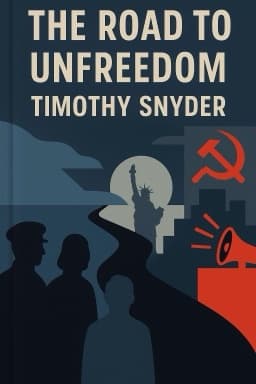
How Russia’s Dark Politics Are Reshaping the World: The Chilling Truth Behind The Road to Unfreedom
Uncover the hidden forces behind modern authoritarianism and how they threaten democracy worldwide.

In an era where truth is often the first casualty, the rise of authoritarianism in Russia and its ripple effects across Europe and America demand urgent attention. Timothy Snyder’s seminal work, The Road to Unfreedom, unravels the complex web of ideology, history, and political strategy that fuels this transformation. This blog explores the core themes of Snyder’s analysis, offering a window into the forces threatening democratic order and individual liberty today.
The Revival of Fascist Ideology in Modern Russia
At the heart of Russia’s political resurgence lies the revival of early 20th-century fascist ideas, particularly those of Ivan Ilyin, a philosopher long exiled and forgotten. His doctrine of a mystical leader embodying national innocence rejects individualism and justifies violence and authoritarian rule. This ideology forms the backbone of what Snyder calls the 'politics of eternity'—a worldview that denies progress and sees history as an eternal struggle against enemies. Unlike the 'politics of inevitability,' which promises a better future, the politics of eternity traps societies in perpetual conflict and victimhood.
Russia’s embrace of this ideology enables the Kremlin to maintain power through manufactured crises, suppression of facts, and the creation of political fiction. Elections are rituals of loyalty rather than genuine democratic processes, and the middle class, once a pillar of civil society, is marginalized. This ideological framework also explains the Kremlin’s aggressive foreign policy, including the annexation of Crimea and interference in Western democracies.
The Crisis of Succession and the Birth of Political Eternity
One of the structural weaknesses of authoritarian regimes is the absence of a clear principle of succession. The Soviet Union’s failure to establish peaceful transfer mechanisms led to violent power struggles and purges. Post-Soviet Russia inherited this instability, which was temporarily masked by oligarchic control. The Kremlin’s covert 'Operation Successor' elevated a previously unknown figure through manufactured crises, such as suspicious bombings in 1999, to consolidate power.
This process gave birth to a 'managed democracy,' where elections are controlled and opposition is co-opted or suppressed. Political stagnation replaces genuine change, and the present becomes eternal. This stagnation fuels narratives of victimhood and external threats, distracting citizens from inequality and corruption.
Europe’s Integration vs. Russia’s Imperial Ambitions
Contrasting sharply with Russia’s imperial vision is the European Union’s integrative model based on shared sovereignty, rule of law, and democratic governance. Born from the ashes of empire and war, the EU represents a hopeful experiment in cooperation and peace among diverse nations.
Russia’s Eurasian project, inspired by fascist-era thinkers, rejects this model in favor of cultural and civilizational unity under Russian dominance. Military interventions, cyber warfare, and support for far-right parties are tools to undermine the EU and expand Russian influence. This geopolitical struggle is not just about territory but about competing visions of governance and the future world order.
Ukraine: The Frontline of Freedom and Imperialism
Ukraine’s history as a medieval Rus state founded by Vikings and its brief moments of independence illustrate the complexity of its national identity. The 2014 Euromaidan protests marked a popular uprising against corruption and Russian influence, leading to a government overthrow and Russia’s annexation of Crimea.
Ukraine’s struggle embodies the politics of novelty—asserting democracy and resisting imperial cycles. Despite war and internal challenges, Ukrainians pursue European integration and democratic renewal, challenging the eternal cycles of domination and victimhood imposed by authoritarian neighbors.
The Weaponization of Truth: Fake News and Information Warfare
Truth has become a weapon in the global political arena. Russia pioneered the use of fake news, cyber attacks, and troll farms to destabilize societies and undermine trust in democratic institutions. These tactics played a significant role in events like the 2016 US election and Brexit referendum, amplifying divisions and spreading misinformation.
In this new form of warfare, facts are blurred, and emotional spectacle replaces rational debate. The challenge for societies lies in reclaiming truth through media literacy, transparency, and historical understanding.
Oligarchy: The Hidden Enemy of Democracy
The rise of oligarchy in post-Soviet Russia has concentrated wealth and power in the hands of a few, undermining democratic equality. Rapid privatization created a powerful elite that manipulates legal systems to protect its interests, deepening social divisions and corruption.
This oligarchic control stifles political renewal and fosters cynicism, as leaders perpetuate inequality while presenting themselves as national saviors. Recognizing and confronting oligarchy is essential for restoring democratic vitality and social justice.
The Path Forward: History, Responsibility, and Hope
Despite these daunting challenges, hope remains. History is not a fixed fate but a dynamic process shaped by individuals who engage critically and courageously. By understanding patterns, rejecting manipulation, and embracing individual responsibility, citizens can reclaim democracy and freedom.
The future depends on active participation, critical thinking, and the reaffirmation of truth and equality. The road to unfreedom is not inevitable; history offers a beacon guiding us toward justice and human dignity.
Explore more about these insights and their implications for our world today by diving into Timothy Snyder’s groundbreaking analysis.
Sources: Amazon - The Road to Unfreedom 1 ; Tipping Point - The Road to Unfreedom Analysis 2 ; YouTube - Timothy Snyder Lecture 3 ; Barnes & Noble - Book Overview 4
Want to explore more insights from this book?
Read the full book summary