
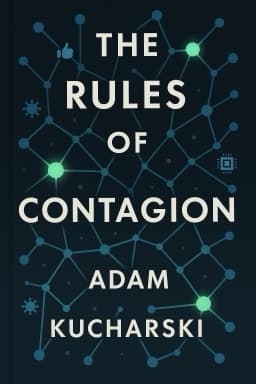
Unlocking the Secrets of Contagion: How Diseases, Ideas, and Fear Spread Like Wildfire
Explore the invisible forces that make epidemics, financial crashes, and viral ideas unstoppable — and how understanding these can change the world.

Across centuries and continents, the invisible threads of contagion have shaped humanity’s fate. From deadly diseases sweeping through populations to the rapid spread of financial panic and viral ideas, the mechanics of contagion reveal surprising unity beneath apparent chaos. Understanding these processes not only satisfies our curiosity but arms us with powerful tools to protect ourselves and our communities.
The Foundations of Contagion: The SIR Model and Herd Immunity
At the heart of outbreak science lies the SIR model — a simple yet powerful framework dividing populations into Susceptible, Infectious, and Recovered groups. This model explains why epidemics typically peak before infecting everyone: as more individuals recover and gain immunity, fewer remain vulnerable, leading to herd immunity. This principle underpins vaccination strategies and disease control worldwide. For example, malaria control efforts showed that reducing mosquito populations below a critical threshold could halt transmission without eradicating every mosquito, a revelation that changed public health forever.
Financial Contagion: When Fear Spreads Faster Than Facts
Financial crises mirror epidemics in their spread through networks of banks and institutions. The collapse of a major bank with over a million counterparties can trigger a cascade of failures, amplified by panic and behavioral responses like hoarding credit or panic selling. The disassortative nature of financial networks — where large banks connect to many smaller ones — facilitates widespread contagion. Paradoxically, diversification strategies can increase systemic risk when many banks hold similar assets, making the system fragile to common shocks.
The Social Web: Ideas, Behaviors, and Complex Contagions
Ideas and behaviors spread through social networks in ways both subtle and profound. Unlike diseases, many social contagions require multiple exposures and social reinforcement to spread — a phenomenon known as complex contagion. The famous spread of Feynman diagrams in physics, with a reproduction number as high as 75 in some regions, illustrates how ideas can propagate slowly but powerfully through persistent influence. The reflection problem complicates studies by making it difficult to distinguish influence from shared environments, but understanding these dynamics is crucial for fostering positive social change.
Violence as Contagion: Breaking the Cycle
Violence, too, behaves like an infectious disease, spreading through social networks with incubation periods and dose-response effects. Exposure increases the likelihood of perpetration or victimization, and community-based interventions using violence interrupters have successfully reduced shootings and homicides. Treating violence as a public health issue opens new pathways for prevention that focus on healing and resilience rather than punishment alone.
Digital Epidemics: Malware and Misinformation
In the digital realm, contagion takes the form of malware spreading through IoT devices and misinformation amplified by social media algorithms. The Mirai botnet, which began targeting Minecraft servers before hijacking hundreds of thousands of devices, caused massive internet outages illustrating how digital epidemics can disrupt modern life. Zero-day vulnerabilities remain a critical challenge, exploited by attackers before patches exist. Meanwhile, misinformation spreads rapidly, creating echo chambers that reinforce false beliefs and behaviors.
Tracing and Controlling Outbreaks with Genetic and Behavioral Data
Advances in genetic sequencing allow scientists to map pathogen transmission with unprecedented precision. Phylogenetic trees reveal origins and pathways of outbreaks, guiding targeted interventions. However, delays in data sharing and privacy concerns pose challenges. Citizen science and interdisciplinary collaboration enhance surveillance, enabling faster, more effective responses.
Conclusion: The Universal Language of Contagion
Contagion is a universal phenomenon transcending biology, finance, sociology, and technology. Each outbreak is unique, shaped by specific factors demanding adaptive responses. Mathematical models translate complexity into clarity, guiding decisions. By embracing interdisciplinary insights and fostering transparency and collaboration, we can better anticipate, prevent, and harness contagion for good, building resilience in an interconnected world.
Want to explore more insights from this book?
Read the full book summary