
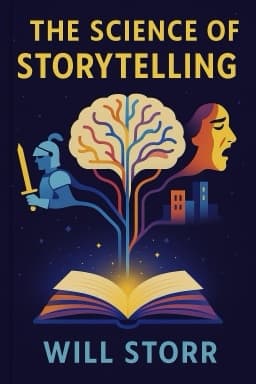
Unlocking Your Brain’s Secret Superpower: Why Stories Hook Us Like Nothing Else
Discover the hidden brain mechanisms that make stories irresistible and how you can harness their power.

Have you ever wondered why a simple story can hold your attention far better than a list of facts or dry instructions? The secret lies deep within your brain's wiring. Neuroscientists reveal that our brains are exquisitely tuned to detect change—unexpected events that disrupt the status quo. This sensitivity to change is not just a survival mechanism but the very foundation of storytelling itself.
The Brain’s Alertness to Change
Imagine walking through your day, and suddenly you hear a loud bang or see a flash of movement. Your brain instantly shifts into high alert. This is because detecting change signals potential danger or opportunity. In stories, this neurological trait is exploited by introducing moments of surprise, conflict, or mystery right at the start, captivating your attention.
But it’s not just sudden change that hooks us; it’s the curiosity sparked by partial information. Our minds crave to fill gaps in knowledge, a phenomenon psychologists call the 'information gap.' When a story hints at a mystery or poses a question, it triggers a drive to seek answers, keeping us engaged.
Constructing Reality: The Brain’s Controlled Hallucination
What you perceive as reality is actually a rich, controlled hallucination created by your brain. Our senses provide fragmented data, and the brain fills in the gaps, crafting a seamless experience. Stories tap into this by painting vivid mental images and emotions, turning words into immersive worlds.
This explains why reading a novel or listening to a tale can feel as real as living the experience itself. Even dreams use the same brain machinery, showing how deeply storytelling is wired into our cognition.
Curiosity and the Dramatic Question
At the heart of every story lies the dramatic question: 'Who is this person really?' Our minds are composed of multiple competing selves, each with conflicting desires and fears. Stories dramatize these internal struggles, amplified by our brain’s tendency to create plausible explanations for our actions, sometimes masking true motives.
Social emotions like moral outrage and status competition further deepen engagement, as we empathize with heroes and despise villains. This emotional rollercoaster mirrors our evolutionary past and keeps us invested in the narrative journey.
Takeaway: Understanding these brain processes empowers storytellers to craft narratives that resonate deeply, and helps audiences appreciate the profound power of stories to shape thought, emotion, and connection.
For more on how neuroscience illuminates storytelling, see the work of Indiana University’s research on narrative brain function, Psychology Today’s insights on fiction’s impact, and NeuroLeadership Institute’s deep dives into brain engagement through stories. 1 , 2 , 3
Want to explore more insights from this book?
Read the full book summary