
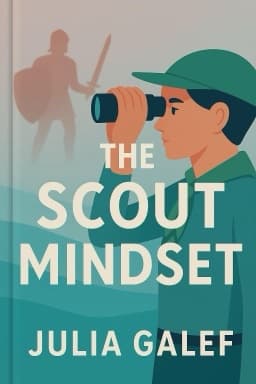
Unlock Your Mind: How The Scout Mindset Can Transform Your Thinking Forever
Discover the secret to seeing the world clearly and making smarter decisions by embracing the Scout Mindset.

Have you ever wondered why it’s so hard to change your mind, even when faced with overwhelming evidence? Or why people cling fiercely to beliefs that seem clearly mistaken to outsiders? The answer lies deep within our psychology, in the battle between two mindsets: the soldier and the scout. Julia Galef’s groundbreaking book, The Scout Mindset, offers a compelling exploration of this internal conflict and shows us a path toward clearer thinking and better decisions.
The soldier mindset is the default mode for most of us. It’s the mental armor that protects our ego, identity, and social belonging. It seeks to defend existing beliefs, often by motivated reasoning—an unconscious process where we twist facts and logic to support what we want to believe. This mindset is emotionally comforting and socially adaptive in many ways, but it distorts reality and blinds us to truth.
In contrast, the scout mindset is the courageous explorer. It values accuracy over comfort, curiosity over defensiveness. Scouts ask, “Is it true?” rather than “Can I believe this?” They welcome criticism, admit mistakes, and revise their mental maps as new evidence emerges. This mindset is not about being cold or detached but about intellectual humility and resilience.
Galef illustrates these ideas with powerful real-world examples, such as historical miscarriages of justice fueled by motivated reasoning and the psychological mechanisms behind rationalizing failures with 'sour grapes' or 'sweet lemons.' These insights reveal why it’s so easy to fool ourselves and how we can begin to resist that impulse.
One of the most practical contributions of the book is its toolkit for detecting bias. Thought experiments like the double standard test and the outsider test help us spot when we are applying different rules to ourselves versus others. Calibration exercises train us to align our confidence with reality, reducing overconfidence and improving judgment.
But embracing the scout mindset isn’t just about intellectual rigor; it’s also about emotional well-being. Contrary to popular belief, facing reality honestly can increase motivation and resilience. The book debunks the myth that optimism requires illusions, showing instead how realistic appraisal and concrete planning foster sustainable motivation.
Finally, Galef tackles the challenge of changing minds gracefully. Since beliefs often intertwine with identity, revising them can feel threatening. The scout mindset encourages holding beliefs lightly, seeing them as provisional maps rather than fixed territories. Incremental updates and supportive communities make belief change less painful and more effective.
In a world flooded with information and complexity, the scout mindset offers a beacon of clarity. It invites us to become lifelong learners, brave enough to face uncertainty and curious enough to seek truth. By cultivating this mindset, we not only improve our decisions but also deepen our understanding of ourselves and others.
Are you ready to unlock your mind and see the world as it truly is? The journey begins with a single step—choosing to be a scout rather than a soldier.
Sources: Freddie deBoer review on Substack, Scott Alexander’s Astral Codex Ten, Goodreads community insights 1 3 4
Want to explore more insights from this book?
Read the full book summary