
Unlocking Your Inner Self: How Tiny Words Reveal Massive Secrets About You
Discover the astonishing power of the smallest words in your language and what they say about your mind, emotions, and social world.

Introduction: The Invisible Giants of Language
Language is more than just the words we choose to express ideas; it is a complex tapestry woven with threads both visible and invisible. While most of us focus on nouns, verbs, and adjectives—the content words that tell stories and convey facts—it is the function words, those tiny pronouns, articles, prepositions, and auxiliary verbs, that silently shape our communication and reveal our inner worlds.
These function words make up nearly 60% of our spoken and written language, yet we barely notice them. Their frequency and subtlety mask their profound power. They reflect our personality traits, emotional states, social connections, and even health conditions. They act as psychological fingerprints, consistent across contexts and time.
Why Function Words Matter More Than You Think
Unlike content words that are chosen deliberately, function words are used unconsciously, making them reliable indicators of our psychological state. For example, frequent use of first-person singular pronouns ('I', 'me') often signals self-focus, which can relate to anxiety or depression. Conversely, use of inclusive pronouns like 'we' reflects social connection and group identity.
Brain studies reveal that function words engage areas related to social cognition and personality, such as Broca’s area. Damage to these regions impairs the use of function words, underscoring their link to social and psychological processes.
Gender, Age, and Social Class: The Linguistic Signatures
Our language style varies systematically by gender, age, and social class. Women tend to use more personal pronouns and social words, while men favor articles and nouns, reflecting different social orientations. Younger people speak with immediacy and personal focus, using many pronouns and present tense verbs, while older adults adopt a more formal, categorical style with more articles and complex vocabulary.
Social class influences language style as well. Higher status individuals use more noun-based, task-oriented language, while those lower in status rely more on pronouns and verbs, highlighting social attentiveness.
Personality, Emotion, and Deception: Language as a Window
Function words also reveal personality traits like extraversion and openness, and cognitive styles such as narrative versus categorical thinking. Emotional states are reflected in shifts in pronoun use and balance of positive and negative emotion words. Expressive writing rich in positive emotion words aids healing and mental health.
Deception alters language patterns too. Liars tend to avoid first-person pronouns to distance themselves and use fewer concrete nouns, while truthful language is grounded in specific details. Conversational synchrony decreases during deception, signaling reduced rapport.
Leadership and Group Dynamics: The Language of Influence
Leaders use language strategically, employing inclusive 'we' pronouns to build group cohesion and reducing self-referential 'I' words to convey confidence. Causal words like 'because' and 'therefore' demonstrate analytical thinking, enhancing authority. In groups, language style matching predicts success and social bonding, while increased 'we' words signal strong collective identity.
Conclusion: The Secret Life of Pronouns Unveiled
Through the lens of function words, we uncover the hidden layers of human psychology embedded in everyday language. These tiny words reveal who we are, how we think, feel, and connect. They offer powerful tools for self-understanding, improving communication, detecting deception, and fostering social bonds.
Next time you speak or write, pay attention to these invisible giants of language. They hold the secret life of your mind and heart.
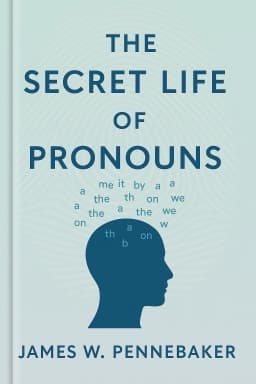
References: Insights from 'The Secret Life of Pronouns' by James W. Pennebaker, complemented by neuroscience and social psychology research. 1 2 3
Want to explore more insights from this book?
Read the full book summary