
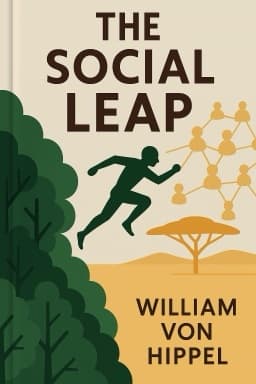
Unlocking the Human Secret: How Cooperation Made Us Masters of the World
Discover the hidden social leap that transformed our ancestors from vulnerable primates to dominant creators of culture and civilization.

Imagine a time millions of years ago when our ancestors lived hidden in dense forests, their survival dependent on agility and camouflage. Suddenly, the forest receded, replaced by vast open savannahs teeming with fierce predators. This drastic environmental shift forced a monumental change—not just in habitat, but in the very fabric of human life.
Survival demanded cooperation. Unlike other animals relying on speed or solitary defense, early humans banded together, throwing stones and using collective vigilance to repel threats. This social leap was accompanied by remarkable physical adaptations: bipedalism freed the hands for weapon use; flexible wrists enabled precise throwing; and the evolution of white sclera made gaze direction visible, enhancing communication and coordination.
These changes were not isolated but deeply intertwined. Cooperation became the engine driving brain expansion and social intelligence. The ability to share attention, intentions, and plans created a feedback loop where social complexity and cognitive capacity grew hand in hand.
Moreover, biological clues such as the evolution of body lice suggest that clothing emerged as humans migrated to colder climates, further illustrating how culture and biology co-evolved in response to environmental pressures.
This foundational chapter of human history reveals that our dominance is not a product of brute strength or individual genius, but the power of social bonds and shared purpose. The collective mind, forged in the crucible of survival, continues to shape our destiny.
Understanding this social leap gives us profound insight into why humans are inherently social creatures, wired for collaboration and empathy. It also sets the stage for the innovations and cultural revolutions that followed, from tool-making to agriculture.
Join us as we journey further into the story of human evolution, uncovering how planning, division of labor, and future thinking propelled Homo erectus across continents and into new realms of possibility.
Sources: Recent evolutionary studies on hominin social behavior, anthropological research on Acheulian tool use, and biological analyses of human eye morphology and parasites 1 , 2 , 3 .
Want to explore more insights from this book?
Read the full book summary