
Unmasking The Spectacle: How Images Control Your Reality More Than You Think
A Deep Dive into Guy Debord’s Vision of a World Dominated by Images and False Consciousness

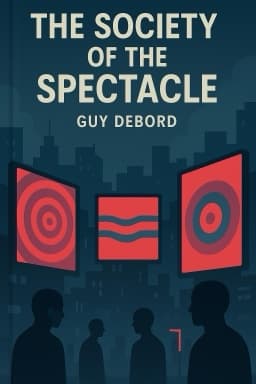
In an age flooded with images, advertisements, and endless streams of media, it’s easy to feel overwhelmed yet disconnected. What if I told you that this isn’t just happenstance but a deliberate social phenomenon described over 50 years ago by the French theorist Guy Debord? His book, The Society of the Spectacle, reveals how modern life has been transformed into a spectacle—a world where images don’t just entertain but dominate and alienate us from reality itself.
Debord argued that the spectacle is not just a collection of images but a social relation mediated by images. This means our interactions, our understanding of society, and even our consciousness are shaped by representations rather than direct experience. The spectacle replaces authentic life with a constant stream of commodified images that create false needs and false unity. For example, think about how social media platforms craft idealized versions of life that people consume and compare themselves against, fostering isolation even as it pretends to connect.
Capitalism lies at the heart of the spectacle. The accumulation of capital transforms into images that dominate social life. Commodities become fetishized objects that mask the labor behind them, and the spectacle is the ultimate expression of this masking. Workers produce goods they do not own, while their labor power is bought and sold, deepening alienation. Advertising and cultural industries manufacture desires for endless consumption, ensuring the spectacle’s endless reproduction.
The spectacle also creates a paradoxical social unity: it reunites people only in their separateness. Celebrities and public figures serve as superficial models, embodying roles that reinforce obedience and consumption but mask genuine social connection. Urban environments are shaped to fragment social life further, with gated communities, surveillance, and consumer zones isolating individuals physically and socially.
Yet, within this bleak picture lies hope. The proletariat—the working class—holds revolutionary potential by becoming the class of consciousness, overcoming alienation through direct democratic organization like workers councils. Culture and time, distorted by the spectacle, still carry the seeds of authentic historical consciousness and meaningful communication. Conscious negation and revolutionary praxis can disrupt the spectacle’s hold, awakening society from its social sleep.
Understanding the spectacle is crucial for anyone seeking to navigate modern life critically and reclaim authentic social relations. By recognizing the spectacle’s mechanisms—from economic foundations to cultural domination—we can begin to resist and imagine a world beyond mere representation.
For more insights, we explore how the spectacle controls urban space, culture, and ideology in the next parts of this series.
Want to explore more insights from this book?
Read the full book summary