
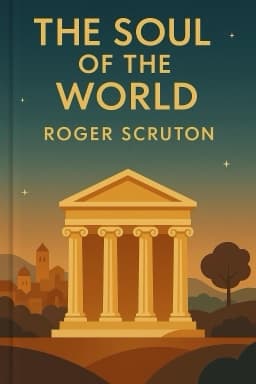
The Hidden Depths of Consciousness and Faith: Insights from Roger Scruton’s Masterpiece
Explore the fascinating intersection of brain science and spirituality through Scruton’s philosophical lens.

Modern neuroscience has made great strides in mapping brain activity, yet it struggles to explain the subjective experience of consciousness and the richness of human personhood. Roger Scruton’s The Soul of the World provides a philosophical framework that respects both scientific discoveries and the irreducible nature of self-awareness.
Scruton explains consciousness as an emergent phenomenon arising from complex neural interactions shared with some animals. However, he emphasizes that the first-person awareness—the 'It seems to me as though...' experience—is not reducible to neural activity. This distinction forms the basis of his critique of reductionism.
Central to his argument is the mereological fallacy: the error of attributing properties of the whole person, such as consciousness and intentionality, to parts of the brain. Consciousness belongs to the whole organism, and understanding it requires acknowledging the person as an integrated being.
Scruton’s concept of cognitive dualism posits two complementary perspectives on humans: as biological organisms and as persons with reasons, intentions, and moral responsibilities. These perspectives are incommensurable but necessary for a full understanding of human nature.
Faith, in Scruton’s view, complements reason by addressing aspects of human experience that science cannot fully capture. The sacred experience is an intersubjective encounter with the divine, a relationship that transcends empirical explanation and invites awe and reverence.
By integrating neuroscience, philosophy, and theology, Scruton offers a holistic approach that honors the complexity of consciousness and the depth of human spirituality. This synthesis challenges reductionist narratives and opens new pathways for understanding the soul of the world.
For those fascinated by the intersection of brain science and faith, The Soul of the World is an indispensable resource.
References: Wall Street Journal review 3 , Insights Scoop 2 , The Guardian 1
Want to explore more insights from this book?
Read the full book summary