
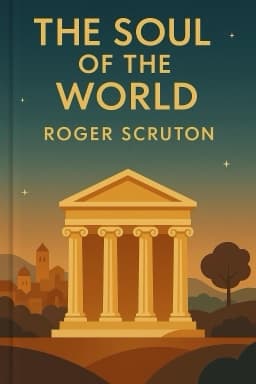
Why Roger Scruton’s ‘The Soul of the World’ Is the Book Every Seeker of Meaning Must Read
Discover how Scruton bridges the gap between science, faith, and the human quest for ultimate meaning.

In an age dominated by scientific materialism and skepticism, Roger Scruton’s The Soul of the World stands as a beacon for those yearning to understand the deeper dimensions of human existence. Scruton does not dismiss science but rather situates it within a broader framework that honors the emotional, social, and spiritual realities that define us.
At the heart of Scruton’s argument is the recognition that faith is not simply a set of doctrines but an emotional response rooted in sacrifice and belonging. This foundational need precedes theology and shapes how humans relate to the sacred. Scruton critiques reductive evolutionary accounts that fail to capture the intentionality and personal experience central to religious belief.
Personhood emerges as a crucial concept, defined by the first-person perspective that grants epistemic privilege over one’s own mental states. This self-consciousness enables moral responsibility, accountability, and meaningful interpersonal relations. Scruton’s notion of cognitive dualism respects both the biological and personal dimensions of human nature.
When addressing consciousness, Scruton warns against the mereological fallacy, emphasizing that consciousness belongs to the whole person, not just brain parts. Neuroscience, while invaluable, cannot fully explain the subjective experience or the conceptual framework in which notions of choice and responsibility reside.
Social life, for Scruton, is grounded in collective intentionality. Rights and duties arise from shared commitments, with claim rights imposing duties and liberty rights granting freedoms. Beyond contractual obligations, transcendent bonds like vows and love create enduring social fabric.
Art and music serve as profound expressions of the sacred. Music, in particular, is a movement in musical space that conveys relational meaning and emotional depth beyond sound waves. Sacred architecture embodies divine presence and social order, creating spaces for transcendent experience. The human face in art symbolizes personhood and relational depth.
Scruton also explores the transcendental urge of reason—the innate human drive to seek ultimate explanations beyond empirical science. This urge connects psychological and cosmological quests, blending faith and reason in the pursuit of God.
Finally, the sacred experience is an intersubjective encounter with the divine, simultaneously revealed and concealed, inviting awe and reverence. This encounter is self-verifying and transcends skepticism.
The Soul of the World is a call to embrace a holistic vision of existence that honors the irreducible sacredness permeating life and cosmos. It challenges readers to see beyond reductionism and find meaning in the integration of faith, reason, and experience.
For seekers of meaning, this book is an essential guide to understanding the profound depths of human spirituality and the soul of the world.
References: Insights Scoop philosophical reflections 2 , Wall Street Journal book review 3 , The Guardian review 1
Want to explore more insights from this book?
Read the full book summary