
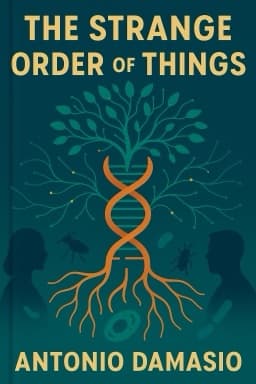
Why Your Gut Feeling Runs the World: The Secret Science Behind Our Emotions
Discover how the body’s ancient wisdom shapes everything from your daily mood to the rise and fall of civilizations.

Discover how the body’s ancient wisdom shapes everything from your daily mood to the rise and fall of civilizations.
Imagine waking up on a stormy morning, your heart racing with anxious anticipation. You might think it’s just the weather—or maybe that extra cup of coffee—but, as Antonio Damasio’s ‘The Strange Order of Things’ reveals, it’s something much deeper. The story of your feelings begins long before your first thought, in the ancient dance of molecules and cells struggling to survive in a chaotic world. This is the story of homeostasis, the body’s relentless drive to keep itself alive and well, and how this silent force gave rise to everything we call human: emotion, reason, and culture.
At the heart of Damasio’s thesis is a radical idea: feelings are not a byproduct of thinking, but the very foundation of consciousness and civilization. Before there were brains, there were cells negotiating with their environment—seeking nutrients, avoiding toxins, and, above all, striving for balance. This ancient imperative, homeostasis, is the reason you feel hunger, thirst, comfort, or pain. But it doesn’t stop there. Over billions of years, homeostasis evolved into a complex symphony of feelings—joy, fear, love, and even awe—that guide every decision you make, even when you think you’re being rational.
Consider the gut. Scientists now call it the ‘second brain’ because it houses millions of neurons and produces the same neurotransmitters as your central nervous system. When you feel butterflies before a big event, or a sinking feeling in your stomach when something’s wrong, it’s not just metaphor—it’s biology in action. The gut sends signals to the brain, shaping your mood, your motivation, and even your creativity. This is why so many ancient healing traditions focus on the belly, and why modern medicine is finally catching up to the wisdom of the body.
But what does this have to do with culture? Everything. Damasio argues that every great leap in civilization—medicine, art, morality—began with a feeling. The urge to heal a wounded friend, to comfort a grieving parent, or to celebrate a harvest is rooted in the body’s drive to reduce suffering and enhance well-being. Even the most abstract achievements—laws, philosophies, religions—are responses to the body’s signals. Culture is, in essence, the collective attempt to regulate life, to create rituals and institutions that help us thrive together.
This perspective turns the usual story upside down. Instead of seeing emotion as an obstacle to reason, Damasio shows that feeling is the engine of progress. Without the pang of empathy, there would be no medicine. Without the thrill of discovery, no science. Without the ache of loneliness, no art or music. Every story you’ve ever heard, every ritual you’ve ever practiced, is a negotiation with the forces of homeostasis—an attempt to bring balance to the chaos of existence.
So, what can you do with this knowledge? First, honor your feelings. They are not weaknesses but ancient guides, helping you navigate a complex world. Second, recognize that your well-being is tied to the well-being of others. Empathy is not just a moral virtue, but a biological necessity—your body is wired for connection. Finally, understand that healing, creativity, and growth are possible when you listen to your body and honor the wisdom of your feelings. In a world that often prizes intellect over emotion, Damasio’s work is a call to balance, to embrace the strange order of things that makes us fully, gloriously human.
References: 4 1 3
Want to explore more insights from this book?
Read the full book summary