From Bondage to Freedom: The Legal and Political Battle for Women's Rights | SnapBooks
Article from Book Summary
From Bondage to Freedom: The Legal and Political Battle for Women's Rights
How legal frameworks have both oppressed and empowered women through history.
Anya Petrova
October 23, 2024442 views
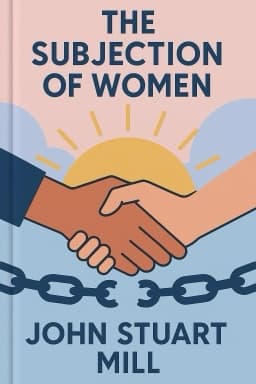
The Subjection of WomenJohn Stuart Mill
From Bondage to Freedom: The Legal and Political Battle for Women's Rights
Introduction: The Legal Shackles
Marriage laws once legally bound women to their husbands, stripping them of property and autonomy. John Stuart Mill described wives as bond-servants, whose legal identity was absorbed by their husbands, enforcing lifelong obedience. This legal framework institutionalized women’s subordination and created profound vulnerabilities.
Property and Autonomy Lost
Upon marriage, a woman’s property became her husband’s, removing her financial independence. This economic control was a cornerstone of legal subjugation, making women dependent and powerless. The denial of property rights limited women’s freedom and reinforced social inequality.
Political Exclusion and Suffrage
Denied the right to vote, women had no political voice to protect their interests. Mill argued that suffrage was essential not only for justice but for women’s self-protection and societal benefit. Women’s suffrage movements challenged this exclusion, leading to gradual political emancipation.
Access to Education and Professions
Excluding women from education and professions deprived society of their talents. Mill emphasized that women’s proven intellectual and moral capacities made them valuable contributors to all fields. Opening doors to education and careers was critical for equality and progress.
Ongoing Legal Challenges
Despite progress, legal inequalities persist in many forms. Understanding the historical roots of these laws helps inform contemporary efforts to achieve full legal equality. The struggle continues for rights in family law, workplace equality, and political representation.
Conclusion
The legal and political emancipation of women is a vital chapter in the story of human rights. Mill’s critiques and the ongoing fight for equality remind us that freedom requires not only laws but vigilance and activism.