
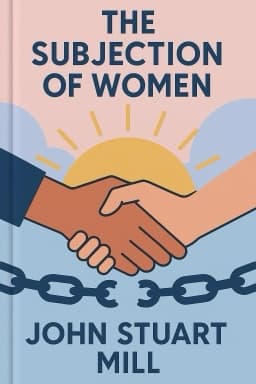
Why John Stuart Mill’s ‘The Subjection of Women’ Still Shakes the Foundations of Gender Equality
Exploring the timeless arguments that challenge societal norms and inspire liberation.

Introduction: A Radical Voice from the Past
In an era when women were legally and socially relegated to second-class status, John Stuart Mill’s 'The Subjection of Women' emerged as a radical manifesto demanding justice and equality.
The Historical Roots of Inequality
Mill traced the origins of women’s subjection to primitive physical dominance, which over centuries became codified into law and custom.
He emphasized that customs, often more powerful than laws, create emotional barriers to reform, as people cling to familiar norms even when they are unjust.
Marriage: The Legal Bond of Subordination
One of Mill’s most powerful critiques was of marriage, which he described as a legal institution that enslaves women.
Mill’s vivid examples expose how marriage, far from being a partnership of equals, was a structure of control, with women reduced to bond-servants within their own homes.
Breaking Barriers: Women’s Fight for Rights
Mill championed women’s access to education, professions, and the vote as essential for their emancipation and societal progress.
Intellectual and Moral Capacities
Contrary to prevailing stereotypes, Mill highlighted women’s unique intellectual qualities such as practical intuition, quick apprehension, and heightened moral sensibility.
The Promise of Equality
Mill envisioned equality as the foundation for moral cultivation and social harmony.
Confronting Myths and Social Conditioning
Mill challenged the myths of natural differences between sexes, showing how social conditioning shapes perceived traits.
Towards Liberation
Ultimately, Mill emphasized women’s agency and self-determination as the path forward.
Conclusion
John Stuart Mill’s 'The Subjection of Women' remains a powerful call to conscience and action. Its profound insights continue to inspire struggles for equality and justice worldwide. Understanding its arguments enriches our appreciation of the ongoing journey toward a more just and free society.
[[0]](#__0) [[1]](#__1) [[2]](#__2)Want to explore more insights from this book?
Read the full book summary