
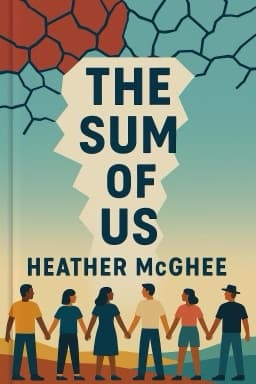
How ‘The Sum of Us’ Reveals the Hidden Price of Racism on the American Dream
Unpacking the economic toll of racial division and the promise of shared prosperity.

Racism is often framed as a social or moral issue, but Heather McGhee’s The Sum of Us breaks new ground by showing its profound economic consequences. From the brutal exploitation of enslaved people, whose lives were treated as appreciating assets, to the predatory lending practices of the 21st century, racism has been a costly economic system that drains wealth from all corners of society.
The book traces how whiteness was constructed as a form of freedom and economic privilege, creating a racial caste that offered psychological and material benefits to white Americans at the expense of others. However, these benefits were never without cost. For example, the refusal to integrate public pools led to their closure, depriving entire communities of valuable public goods. Similarly, cuts in public education funding and opposition to Medicaid expansion have worsened economic insecurity for many.
Perhaps most striking is the analysis of the 2008 financial crisis. The securitization of risky subprime loans, many targeted at Black and brown homeowners, triggered a global economic meltdown. The resulting foreclosures wiped out decades of accumulated wealth, especially in communities of color, exacerbating the racial wealth gap.
Yet, McGhee’s analysis does not end in despair. She introduces the concept of the Solidarity Dividend—economic and social benefits that arise when people unite across racial lines to demand fair policies. Evidence from multiracial coalitions shows that shared investment in public goods, education, and healthcare strengthens economies and improves lives for all.
This economic perspective challenges us to rethink how we understand inequality and the American Dream. It calls for dismantling the zero-sum myths that divide us and embracing solidarity as a path to true prosperity.
Sources: 3 , 2 , 1
Want to explore more insights from this book?
Read the full book summary