
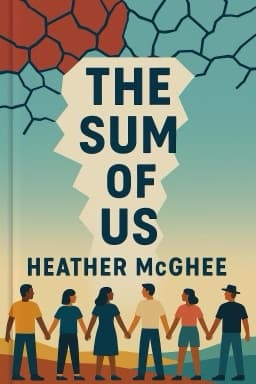
The Sum of Us: How Racism Costs Everyone — And How We Can Win Together
Discover the hidden cost of racism on all Americans and the transformative power of solidarity.

At the heart of Heather McGhee’s The Sum of Us lies a profound and unsettling truth: racism is not a problem isolated to people of color. Instead, it is a systemic force that erodes the well-being and prosperity of all Americans, including white people. This book challenges the dominant narrative of zero-sum thinking—the idea that gains for one racial group must come at the expense of another—and reveals how this mindset has shaped policies and attitudes that ultimately harm everyone.
McGhee traces the roots of racial hierarchy back to colonial America, where whiteness was constructed as a form of freedom in opposition to Black enslavement. This early racial order laid the foundation for economic and social systems that privileged white Americans while exploiting people of color. However, the benefits of this system came at a steep cost: the erosion of public goods and social trust. For example, the closure of public swimming pools in the South rather than integrating them exemplifies how white resistance to sharing resources led to losses for entire communities, not just Black residents.
One of the most striking insights from the book is how racial resentment and fear have driven disinvestment in essential public services like education, healthcare, and housing. McGhee highlights how declining state funding for public colleges has shifted the burden to students, disproportionately affecting Black and brown students who often carry higher debt burdens. Similarly, opposition to Medicaid expansion in many states, fueled in part by racialized politics, has led to rural hospital closures and worse health outcomes.
The 2008 financial crisis is another critical chapter in this story. Predatory lending targeted homeowners of color with risky loans, stripping wealth and destabilizing neighborhoods. These loans were bundled into complex securities that spread financial risk globally, leading to a devastating economic collapse. The crisis erased decades of wealth for many Black families and widened the racial wealth gap.
Labor and political power have also been fractured by racial divisions. Unions historically excluded workers of color, weakening collective bargaining power. Felony disenfranchisement laws disproportionately suppress the votes of people of color, further diluting political influence. Meanwhile, the influx of money into politics exploits racial fears to maintain elite control, undermining democracy.
Residential segregation remains a stubborn legacy, with redlining maps and housing policies confining communities of color to underinvested neighborhoods. This segregation affects schools, transportation, and economic opportunity, perpetuating cycles of poverty. Environmental racism compounds these inequities, as toxic facilities are disproportionately located near communities of color, leading to higher rates of illness.
Beyond the material costs, McGhee delves into the emotional and psychological toll of racism. Chronic stress, trauma, and social isolation affect both people of color and white Americans grappling with guilt and denial. Healing requires truth-telling, cross-racial solidarity, and collective action to rebuild trust and resilience.
The book culminates in the concept of the Solidarity Dividend—the idea that when we come together across racial lines, we unlock prosperity, justice, and a stronger democracy for all. Multiracial coalitions have already won historic reforms and increased voter engagement, proving that unity is not only morally right but pragmatically essential.
In sum, The Sum of Us is a clarion call to reject division and embrace our shared humanity. It offers a roadmap to a future where equity and solidarity create a society that truly works for everyone.
For anyone seeking to understand the deep roots of racial inequality and the pathways to collective healing, this book is indispensable.
Sources: 1 , 2 , 3
Want to explore more insights from this book?
Read the full book summary