
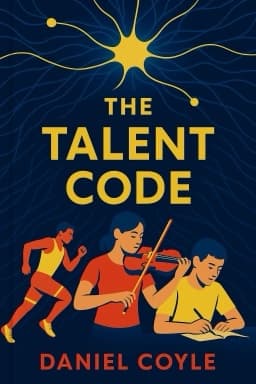
Unlocking Genius: The Shocking Science Behind Talent That Anyone Can Use
Discover the hidden code that turns ordinary effort into extraordinary achievement.

Discover the hidden code that turns ordinary effort into extraordinary achievement.
For generations, we’ve been captivated by the dazzling performances of athletes, musicians, and thinkers who seem to possess a mysterious, innate gift. But what if talent isn’t a divine spark, but a skill anyone can build? Daniel Coyle’s groundbreaking book, The Talent Code, reveals a new science of greatness—one that is as surprising as it is empowering.
At the heart of this revelation is the story of myelin, the brain’s miraculous insulator. Myelin wraps around neural circuits, making them faster and more accurate with every correct repetition. This means that every time you practice a skill—whether it’s playing piano, swinging a bat, or solving equations—you’re literally rewiring your brain for excellence. Talent, Coyle argues, is not born. It’s grown, layer by layer, through a process called deep practice.
What does deep practice look like? It’s not mindless repetition, but focused struggle at the edge of your abilities. It’s the violinist playing a tricky passage slowly, correcting each note; the soccer player breaking down a feint into tiny parts; the chess master replaying a match move by move. Deep practice is making mistakes, fixing them, and repeating the cycle until perfection becomes second nature. This process turbocharges myelin growth, turning effort into expertise.
But skill-building is not just about biology—it’s about environment and motivation. Coyle introduces us to 'talent hotbeds'—small, often humble places that consistently produce world-class performers. Whether it’s a rundown tennis court in Moscow or a music school in Dallas, these environments share three ingredients: deep practice, ignition (the spark of motivation), and master coaching. In these hotbeds, struggle is celebrated, mistakes are embraced, and every achievement is built on a mountain of effort.
Ignition is the emotional fuel for this journey. It’s the moment when a young athlete sees someone like them succeed and thinks, 'If they can do it, so can I.' This spark transforms dreams into plans and sustains the hard work of deep practice. The power of group identity and visible role models is so strong that a single breakthrough can trigger a wave of talent in a community, as seen in the explosion of South Korean women golfers after one champion’s victory.
Master coaching ties it all together. The best teachers and coaches don’t lecture endlessly—they guide with brief, actionable feedback, encourage risk-taking, and praise effort over innate ability. They create cultures where mistakes are opportunities, not failures, and where every student feels seen and supported. The result? A self-reinforcing cycle of growth, resilience, and achievement.
This new science of talent has profound implications. It means that anyone, at any age, can start building skill. It means that setbacks and frustration are not signs of failure, but proof that you’re on the path to mastery. And it means that by engineering your environment—breaking tasks into chunks, creating feedback loops, and celebrating effort—you can unlock potential in yourself and others.
So, the next time you marvel at a world-class performance, remember: it’s not a gift, but a process. And with the right approach, that process is available to all of us. The Talent Code is more than a book—it’s a blueprint for greatness, waiting for you to pick up and use.
Sources: 1 2 3
Want to explore more insights from this book?
Read the full book summary