
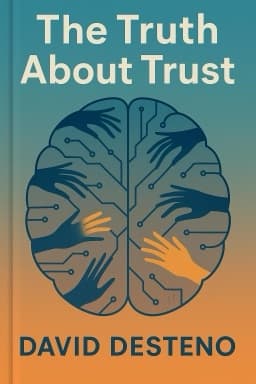
Why You Can’t Afford to Ignore Trust: The Science That Will Change How You Connect
How understanding the biology and psychology of trust can revolutionize your personal and professional relationships.

Trust is more than a social nicety; it’s a biological imperative woven into the very fabric of our being.
Evolutionary psychology reveals that primates share a sense of fairness and an aversion to inequity, behaviors that underpin trust and cooperation. Observations of monkeys refusing unequal rewards show that these instincts are automatic and deeply rooted, not learned behaviors. This evolutionary heritage explains why humans are predisposed to seek fairness and trustworthiness in social partners.
Oxytocin, often dubbed the 'moral molecule,' plays a dual role. While it promotes bonding and trust within groups, it can also increase suspicion toward outsiders, highlighting trust’s context-dependent nature. This duality reflects the evolutionary need to protect one’s own group while navigating a complex social world.
Trust begins in infancy, shaped by attachment styles with caregivers. Secure attachment fosters confidence and a preference for competent, familiar teachers, while insecure styles can hinder trust development. These early experiences influence how we learn, whom we trust, and how we form relationships throughout life.
In adult romantic relationships, trust is dynamic and fluctuates with emotional states. Positive illusions created by trust help partners forgive faults and maintain intimacy, while jealousy can act as a protective mechanism to preserve the relationship. Trust involves both rapid intuitive judgments and slower reflective reasoning, explaining the complexity of human emotions in love.
Power and money introduce complications. Power increases dishonesty and reduces empathy, while money primes self-sufficiency and decreases cooperation. However, leaders who cultivate empathy and fairness can mitigate these effects, fostering environments where trust thrives.
Humans detect trustworthiness through subtle behavioral cues that intuition rapidly processes. These signals are multi-faceted and context-dependent, making trust detection an art as much as a science. Deception complicates this process, requiring experience and awareness to navigate effectively.
Understanding these biological and psychological foundations of trust equips us to build stronger, more resilient relationships. By recognizing the forces at play, you can foster trust intentionally and navigate social complexities with greater wisdom.
References: The Truth About Trust, Greater Good Science Center, Blinkist summary 1 3 2
Want to explore more insights from this book?
Read the full book summary