
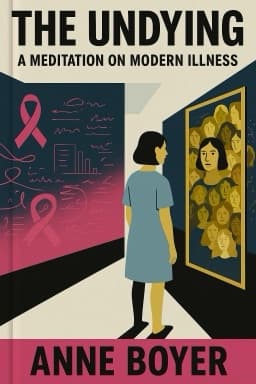
The Undying: Why Anne Boyer’s Cancer Memoir Will Change How You See Illness Forever
A radical meditation on suffering, care, and the politics of survival

A radical meditation on suffering, care, and the politics of survival
There is a moment in every life when the ordinary world is split open by illness. For Anne Boyer, that moment arrived with a diagnosis of one of the deadliest forms of breast cancer. But 'The Undying' is not just a story about cancer—it’s a story about everything that surrounds it: the history, the economics, the gender politics, and the collective labor that makes survival possible. Boyer’s memoir is a rallying cry against the commercialization of pink-ribbon culture, a sharp critique of the profit-driven medical system, and a love letter to the caregivers and companions who refuse to let anyone suffer alone.
From the very first pages, Boyer refuses the easy narrative of the brave survivor. Instead, she exposes the violence of medical language, the coldness of statistical prognosis, and the loneliness of being reduced to a data point. She asks: What does it mean to be a patient in a system that values profit over people? Her answer is both deeply personal and fiercely political, drawing connections between her own suffering and the broader history of women’s pain, medical exploitation, and the commodification of illness.
Boyer’s writing is unsparing in its honesty. She describes the ravages of chemotherapy—the cognitive fog, the physical debilitation, the financial devastation—with a clarity that refuses sentimentality. Yet, she also finds moments of beauty and solidarity in the small acts of care: a friend bringing soup, a nurse’s gentle touch, a community rallying to share burdens. These moments, she argues, are the true antidote to the isolation of illness.
One of the book’s most powerful threads is its critique of the pink-ribbon industry. Boyer traces the history of breast cancer awareness campaigns, exposing how corporate interests have turned collective suffering into a marketing opportunity. She challenges readers to see beyond the slogans and to ask hard questions about who benefits from the commodification of disease—and who is left behind.
Throughout, Boyer weaves in the voices of other writers, artists, and patients. She draws on literary and philosophical traditions to show that illness is not just a medical event, but a cultural and historical phenomenon. Her prose is both lyrical and analytical, moving seamlessly between personal narrative and social critique.
Ultimately, 'The Undying' is a book about resistance. Boyer insists that to survive illness is not just to endure, but to refuse erasure—to insist on being seen, heard, and cared for. Her story is a call to action: to build systems of solidarity, to demand justice in healthcare, and to honor the invisible labor of care that sustains us all.
For anyone who has faced illness, loved someone who has, or wondered about the true cost of survival, 'The Undying' is essential reading. It will change the way you think about sickness, care, and what it means to live—and die—in our time.
Want to explore more insights from this book?
Read the full book summary