
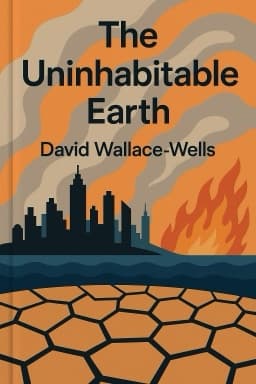
The Uninhabitable Earth: Why Climate Change Is Closer Than You Think
What If Everything You Feared About Climate Change Wasn't Enough?

What If Everything You Feared About Climate Change Wasn't Enough?
Imagine waking up to a world where the air is thick with smoke, summers are unbearably hot, and food prices double overnight. This is not a distant dystopia; it’s the near future described by David Wallace-Wells in his groundbreaking book, The Uninhabitable Earth. The book opens with a stark warning: ‘It is worse, much worse, than you think.’ Wallace-Wells pulls no punches, drawing on the latest climate science and real-world examples to show that the climate crisis is not a slow-moving threat, but a rapidly accelerating emergency.
He explains the concept of feedback loops—how melting Arctic ice exposes dark ocean water, absorbing more heat and speeding up the melt. The same principle applies to permafrost releasing methane, wildfires darkening the skies, and droughts destroying crops. These are not isolated events, but interconnected disasters that can trigger economic collapse, mass migration, and even war.
But the book is not just about doom. Wallace-Wells delves into the psychology of climate denial and the stories we tell ourselves to avoid facing uncomfortable truths. He discusses the ‘good-news bias’—our tendency to downplay worst-case scenarios—and the power of narrative in shaping public response. For example, while media often focuses on sea-level rise, the real threats may be heatwaves and food insecurity.
One of the most striking sections explores inequality: the poorest nations, which contributed least to the problem, are suffering the most. Wallace-Wells highlights the rise of climate refugees, the challenge of international cooperation, and the moral imperative for environmental justice.
He also offers hope, describing how cities are adapting with green roofs, how technology like drones are planting forests, and how grassroots movements are changing the political landscape. The book ends with a call to action: we are still in command of our fate, and every choice matters. Hope, Wallace-Wells argues, is not naïve optimism—it’s the courage to act despite uncertainty.
In summary, The Uninhabitable Earth is a must-read for anyone who wants to understand the true scale of the climate crisis and what we can do about it. It’s a book that challenges, inspires, and, above all, refuses to let us look away.
Want to explore more insights from this book?
Read the full book summary