
From Tree Dwellers to Quantum Dreamers: The Epic Human Journey You Never Knew
How Our Ancestors’ Curiosity Shaped the World—and Still Drives Us Forward

How Our Ancestors’ Curiosity Shaped the World—and Still Drives Us Forward
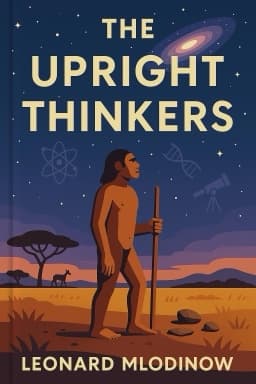
Imagine a time when our ancestors gazed out from the safety of the trees, their future uncertain, their world mysterious. What set them apart from the other creatures was not just their ability to walk upright, but an insatiable curiosity—a desire to understand, to explore, to ask, 'Why?' This single trait, as Leonard Mlodinow masterfully reveals in 'The Upright Thinkers,' is the force that propelled humanity from primitive survival to the heights of scientific achievement.
Our story begins millions of years ago, with the evolutionary leap that freed our hands for tool-making. This was more than a physical change; it was a gateway to imagination. With every stone flake and sharpened stick, early humans began to shape their environment, and in doing so, they shaped themselves. But it wasn’t enough to merely survive. Around the flickering light of ancient campfires, they began to share stories, create rituals, and paint their dreams on cave walls. Culture was born, and with it, the first sense of meaning beyond the immediate struggle for life.
As communities grew, so did the complexity of their interactions. The invention of writing was a revolution—no longer were ideas and knowledge bound by memory or geography. Clay tablets and later parchment preserved the wisdom of generations, allowing societies to build upon the past rather than start anew each time. Mathematics emerged as a tool for managing resources, constructing cities, and predicting the cycles of nature. Law, both social and cosmic, brought order and a sense of justice, blending the sacred with the practical.
The Greeks transformed the world by daring to ask if the cosmos could be understood through reason rather than myth. Thales predicted eclipses, Pythagoras saw numbers in music, and Aristotle systematized knowledge in ways that would endure for centuries. Their legacy was a new way of thinking—one that valued observation, logic, and debate.
The Renaissance and the Scientific Revolution exploded with new ideas, fueled by the printing press and a spirit of fearless inquiry. Galileo’s telescope revealed moons orbiting Jupiter, Newton’s laws united the heavens and the earth, and the quantum revolution shattered our expectations of reality itself. Each breakthrough was born not just of intellect, but of the courage to say, 'We do not know—yet.'
Today, we stand on the shoulders of these upright thinkers. The boundaries of knowledge are not walls, but horizons that recede as we move forward. Uncertainty is not a flaw, but an invitation to wonder. Science is a communal journey, built on the dreams and discoveries of countless individuals, united by a shared passion for understanding.
As you reflect on this journey, remember: the questions you ask today may become the answers that inspire tomorrow. The story of humanity is not finished—it is being written, line by line, by each of us. Embrace your own curiosity, and join the adventure that has defined our species since we first stood tall and dared to dream.
Want to explore more insights from this book?
Read the full book summary