
How Behavioral Economics Powers Your Scaling Strategy
Harness the Science of Human Behavior to Design Incentives That Drive Explosive Growth

Scaling ideas successfully requires more than good products or processes—it demands understanding the human mind. Behavioral economics reveals that people don’t always act rationally; they are influenced by biases and heuristics that can be leveraged or can sabotage scaling efforts.
Loss Aversion: The Power of Avoiding Loss
People feel losses more acutely than equivalent gains. A wellness program that framed rewards as something participants might lose if they didn’t comply saw higher engagement than one offering equivalent gains. This simple insight can transform incentive design.
Marginal Thinking: Focus on the Next Step
Instead of overwhelming teams with massive goals, focusing on marginal gains—the impact of the next dollar or action—optimizes resource allocation. For example, a delivery app improved efficiency by iteratively testing and refining routes, yielding compounding benefits.
Designing Sustainable Incentives
Incentives must be sustainable and avoid perverse outcomes. Overly generous rewards can create dependency, while poorly aligned incentives can encourage gaming the system. Aligning incentives with culture and values ensures long-term voltage.
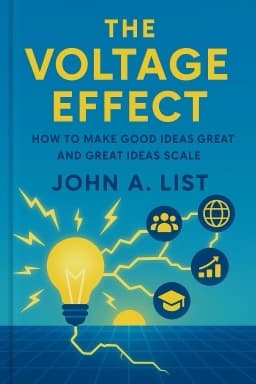
Behavioral economics provides a toolkit for leaders to engineer voltage gains. This blog integrates John List’s insights with real-world examples and behavioral science research to guide your scaling strategy. 3 4
Want to explore more insights from this book?
Read the full book summary