
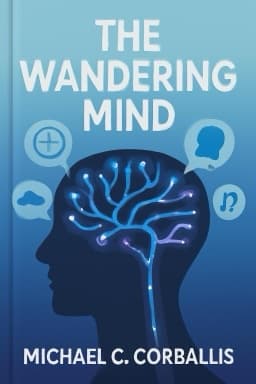
The Brain’s Secret Superpower: How Mind-Wandering Sparks Creativity and Empathy
Unveil how your brain’s default mode network fuels not only creativity but also empathy and social understanding.

While many view mind wandering as a lapse in attention, neuroscience reveals it as a superpower of the human brain. The default mode network (DMN), active during these moments, supports a suite of cognitive functions essential for creativity and social connection.
The hippocampus, a seahorse-shaped structure deep in the brain, is central to these processes. It helps us form cognitive maps, enabling mental navigation through space and time. This function is crucial for remembering past experiences and imagining future possibilities, a capacity known as mental time travel.
Social cognition, including theory of mind—the ability to understand others’ beliefs and intentions—also relies on these networks. Children develop this ability around age four, which is foundational for empathy, cooperation, and complex social behaviors.
Interestingly, domesticated dogs outperform chimpanzees in understanding human gestures, highlighting how social evolution shapes cognition. Storytelling and imagination extend these social mind wanderings, allowing us to share experiences and build culture.
Dreams and hallucinations further demonstrate the brain’s capacity to generate rich internal experiences, blending memory, emotion, and perception. These phenomena reveal that our conscious experience is an active construction, not a passive reception of reality.
Creativity emerges when the mind wanders freely, integrating diverse brain regions across hemispheres. Incubation periods, where conscious effort pauses, allow unconscious processing to foster novel insights and problem-solving.
Recognizing mind wandering as a cognitive superpower invites us to embrace our spontaneous thoughts as sources of innovation and connection, enriching our personal and social lives.
References:
- Mind Wandering and the Intuitive Psychology Mode - NCBI 1
- Mind-wandering as Creative Thinking - ResearchGate 3
- Relations between Imagination and Creativity - ResearchGate 4
Want to explore more insights from this book?
Read the full book summary