
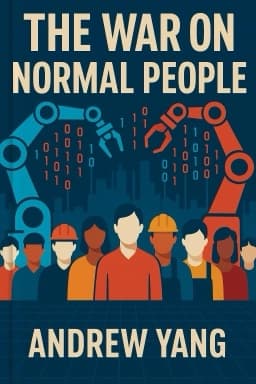
Is Automation Stealing Your Job? The Shocking Truth Behind 'The War on Normal People'
How AI and Robotics Are Reshaping the Workforce and What It Means for You

How AI and Robotics Are Reshaping the Workforce and What It Means for You
Imagine waking up one day to find that your job—and the jobs of millions around you—have vanished, not because of economic downturns or offshoring, but because a robot or an algorithm can do it better, faster, and cheaper. This is not a dystopian science fiction scenario; it is the reality unfolding now, as detailed in Andrew Yang's groundbreaking book, The War on Normal People. Yang, an entrepreneur and former presidential candidate, paints a vivid picture of the 'Great Displacement,' a wave of automation that threatens to upend the livelihoods of millions of middle-class Americans.
Since the year 2000, over 4 million manufacturing jobs have disappeared in the United States, largely due to automation rather than globalization. But it's not just factories—retail stores are closing by the thousands, call centers are being replaced by AI chatbots, and self-driving vehicles threaten to eliminate millions of driving jobs. The impact is profound: the labor force participation rate has dropped to a historic low of 62.9%, signaling that many prime-age workers have given up looking for work.
Yang emphasizes that the average American worker—the 'normal person'—is often someone without a college degree, earning modest wages and living paycheck to paycheck. These workers are particularly vulnerable to displacement because the new jobs created by technology often require advanced skills and education they may not possess.
The human toll is heartbreaking. Communities once thriving around factories and retail hubs are now struggling with poverty, mental health crises, and social fragmentation. Disability claims have surged as displaced workers seek financial relief, and social problems like substance abuse and family instability have increased. The book forces us to confront not just economic statistics but the lived realities of millions.
Yang’s proposed solution is bold and controversial: Universal Basic Income (UBI). By providing every adult with a guaranteed income, UBI aims to decouple survival from employment, offering financial security amid uncertainty. Trials around the world have shown that basic income can improve well-being, increase entrepreneurship, and reduce poverty.
Beyond UBI, Yang advocates for a broader reimagining of capitalism—what he calls Human Capitalism—where the economy serves people, not profits alone. This includes reforming health care and education to be accessible regardless of employment status and fostering social currencies like time banking to reward community contribution.
As automation accelerates, the choices society makes will determine whether technology becomes a tool for abundance or a source of inequality. Yang’s message is clear: we must act now with compassion, innovation, and courage to build a future where everyone can thrive.
Whether you are a worker worried about job security, a policymaker seeking solutions, or simply curious about the future of work, 'The War on Normal People' offers essential insights and a call to action that cannot be ignored.
Explore the following sections to dive deeper into the realities of automation, the profile of the average American worker, the jobs most at risk, the human cost of displacement, and the transformative ideas that could shape a just and prosperous future.
Want to explore more insights from this book?
Read the full book summary