
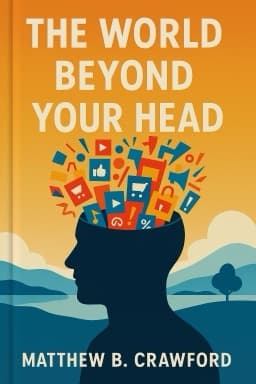
Unlocking Your Mind’s Hidden Power: How Attention Shapes Reality and Autonomy
Discover the revolutionary insights into how our attention is shaped by the world around us and how reclaiming it can transform your life.

In today's hyper-connected world, attention is under siege. Our minds are pulled in a thousand directions by flashing screens, relentless notifications, and carefully crafted advertisements that invade every public space. But attention is not just a private mental commodity—it is a shared resource, an "attentional commons" akin to clean air or water. When this commons is polluted by commercial interests and digital distractions, our capacity for deep focus, creativity, and genuine autonomy suffers profoundly.
Consider the environments we inhabit. From the coffee-scented buses in Seoul designed to nudge consumption to the physical jigs that craftsmen and cooks use to reduce mental load, our surroundings shape how we think and act. Jigs are environmental scaffolds—tools or arrangements that constrain actions to make complex tasks manageable. Nudges, by contrast, steer behavior often without our awareness, raising ethical questions about autonomy and consent.
These concepts reveal that cognition extends beyond the brain into the body and environment, a principle known as extended cognition. For example, a hockey player perceives the puck not just through his eyes but through the stick he wields, which becomes a transparent extension of his body. Active movement is essential for perception; studies with kittens show that passive observation fails to develop normal visual skills, underscoring the inseparability of perception and action.
Yet, modern mediated realities, such as those presented in children’s media and virtual experiences, often insulate us from the unpredictability of the physical world. Early Disney cartoons embraced the frustrations and resistance of material objects, while contemporary shows offer frictionless problem-solving that shields children from real challenges. This shift reflects a philosophical ideal of autonomy that emphasizes abstraction from the world, but it risks creating fragile selves reliant on representations rather than embodied engagement.
Design plays a crucial moral role here. Modern car dashboards with digital controls can sever drivers from direct sensory feedback, fragmenting attention and increasing risk. Thoughtful design that supports embodied interaction and cross-modal sensory binding can enhance agency and safety, while poor design undermines them.
Some designed experiences, like slot machines, exploit cognitive vulnerabilities by offering perfect contingency—actions reliably produce expected outcomes—inducing trance-like absorbed states that diminish genuine agency. This invites reflection on the ethical responsibilities of designers and society in shaping attentional landscapes.
Attention is also deeply social. Ethical attention requires recognizing others’ claims and presence. Phone use while walking or driving reduces social engagement and increases dangers, whereas having a passenger improves driver attention through cooperative interaction. The culture of performance, amplified by social media, fragments identity into curated personas, challenging authenticity and deep self-understanding.
Counterbalancing this fragmentation is the erotics of attention—a form of connection characterized by vulnerability, mutual recognition, and admiration. This intimate attention affirms individuality and sustains vibrant social life.
Finally, tradition and apprenticeship provide grounding. Engaging with living traditions cultivates character and situated agency, offering a cultural jig that shapes habits and coherent individuality over time. In a distracted world, these rooted practices offer a path to reclaim attention, agency, and meaningful life.
This journey through attention, cognition, design, and sociality invites us to rethink how we inhabit our minds and bodies, urging us toward deeper presence, ethical engagement, and flourishing.
Want to explore more insights from this book?
Read the full book summary