
Why ‘Thick’ Is the Must-Read Book Changing How We See Black Womanhood
Unpacking the Layers of Identity, Power, and Resistance in Tressie McMillan Cottom’s Groundbreaking Essays

Unpacking the Layers of Identity, Power, and Resistance in Tressie McMillan Cottom’s Groundbreaking Essays
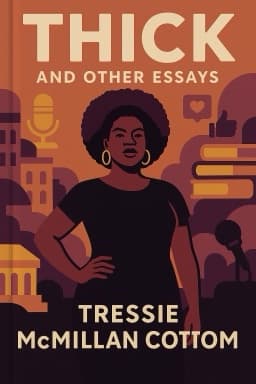
Tressie McMillan Cottom’s Thick: And Other Essays is more than a collection of personal essays; it is a profound exploration of what it means to live at the intersections of race, gender, and class in contemporary America. Through a lens of 'thick description,' Cottom invites readers to immerse themselves in the lived realities of black women, revealing the nuanced and often painful ways identity is shaped by social location and systemic forces.
One of the most striking themes in Thick is the politics of beauty. Far from being a mere matter of aesthetics, beauty standards operate as a racialized economic system that systematically excludes black women. Cottom deftly illustrates how whiteness functions as the dominant norm, setting a standard that many strive to meet at great personal and financial cost. This system not only marginalizes but also inflicts symbolic violence—the psychological harm of internalizing oppressive ideals. Yet, amid these challenges, black women resist by crafting counternarratives and cultural expressions that celebrate black beauty on their own terms, from hair politics to hip-hop culture.
Another critical insight is Cottom’s concept of structural incompetence—the systemic assumption that black women are less competent, especially in healthcare and professional settings. This assumption leads to neglect, misdiagnosis, and exclusion that no amount of individual effort can fully overcome. For example, black women face maternal mortality rates more than twice that of white women, a disparity rooted not in biology but in institutional failure and bias. These realities expose the limits of meritocracy and highlight the urgent need for systemic change.
Building on these themes, Cottom unpacks the elastic paradox of whiteness—a social construct that expands or contracts to maintain dominance, using blackness as its counterpoint. This dynamic explains the persistent racial hierarchies and the complex interplay of inclusion and exclusion in American society. Furthermore, the book explores the contested nature of black identity itself, especially the tensions between 'black ethnics' (immigrants and diasporic blacks) and black Americans descended from enslaved Africans. These divisions are intensified by scarcity of representation and resources, complicating notions of authenticity and belonging.
In the face of exclusion, black women have turned to storytelling and personal essays as means to claim public voice and intellectual authority. Digital media platforms have amplified these voices, creating alternative spaces for expression and resistance. The metaphor of 'fixing one’s feet' captures the ongoing labor and resilience black women perform to navigate systemic barriers and assert their presence despite societal erasure.
Ultimately, Thick offers a hopeful vision of transformation grounded in collective empowerment and solidarity. It challenges readers to recognize the value of black women’s experiences and contributions, advocating for a future where their voices are not only heard but celebrated and rewarded. This book is essential reading for anyone committed to understanding and dismantling systemic inequality and embracing the richness of black womanhood in all its complexity.
For those eager to engage deeply with contemporary social issues through the lens of race, gender, and power, Thick is a transformative and enlightening journey. It is a call to listen, learn, and act toward a more just and inclusive society.
Sources: 1 , 2 , 3 , 4
Want to explore more insights from this book?
Read the full book summary