
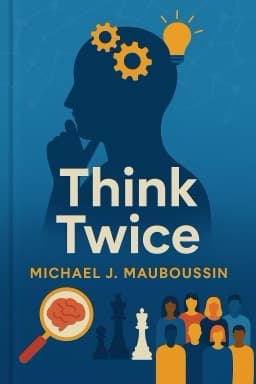
Think Twice: The Counterintuitive Secrets to Outsmart Your Own Mind
Unlock the Hidden Forces That Shape Your Decisions and Learn to Outsmart Your Mind

Have you ever felt certain about a decision, only to be surprised by the outcome? That feeling is more common than you think, and it stems from the quirks of human cognition. Michael Mauboussin’s book Think Twice reveals how our minds often mislead us through subtle illusions and biases, and how counterintuitive thinking can help us make better choices.
At the heart of the book is the distinction between the 'inside view' and the 'outside view.' The inside view focuses on the unique details of your situation—your skills, plans, and hopes—leading often to overconfidence and optimism bias. For example, a horse trainer might believe their champion will win the Triple Crown because of inside knowledge, ignoring that historically only 15% of horses in similar positions have succeeded. The outside view, by contrast, looks at statistical data from a reference class of similar cases to ground predictions in reality. This approach helps counter the illusions of control and optimism that cloud our judgment.
Another key insight is the power and pitfalls of experts versus crowds. While experts excel in strategic and creative tasks, they often fail to outperform simple algorithms or collective intelligence in rule-based domains. For instance, a prediction market at a company forecasted sales with 99.5% accuracy, beating expert estimates. Similarly, Netflix’s recommendation algorithm outperformed video store clerks by analyzing vast data consistently. This highlights the importance of understanding when to trust expertise and when to leverage crowd wisdom or algorithms.
The book also delves into how social environments and subtle cues influence decisions unconsciously. Classic experiments show that about 40% of people conform to incorrect group answers, and ambient music in stores can sway wine purchases toward certain countries. These invisible forces—social conformity, priming, defaults—shape choices beyond our awareness, underscoring the need for situational awareness.
Understanding complexity is another pillar. Complex adaptive systems, like bee colonies or crowds on a bridge, exhibit emergent behaviors where the whole is greater than the sum of parts. Small triggers can cause phase transitions—sudden large-scale shifts—making prediction and control difficult. This demands humility and adaptive management rather than rigid plans.
Perhaps most practically, Mauboussin advocates tools like decision journals and premortems to improve judgment. Recording decisions and imagined failure scenarios fosters reflection, uncovers hidden risks, and reduces overconfidence. Slowing down to think twice helps counter impulsive errors and cognitive shortcuts.
Ultimately, Think Twice teaches us to balance intuition with analysis, embrace uncertainty, and cultivate habits of reflection and learning. By recognizing the illusions that cloud our minds and applying counterintuitive strategies, we can make wiser decisions that stand the test of time.
Whether you’re an investor, manager, or simply someone striving to think more clearly, these lessons offer a roadmap to navigating complexity with grace and insight.
Ready to outsmart your mind? The journey begins by thinking twice.
1 , 2 , 3 , 4
Want to explore more insights from this book?
Read the full book summary