
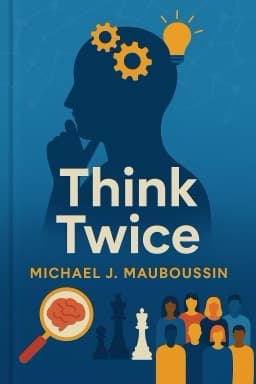
Why Your Intuition Is Wrong and How to Think Twice Before Deciding
Discover the Hidden Biases Behind Your Gut Feelings and Learn to Outsmart Them

Our brains are wired for speed and efficiency, creating shortcuts called heuristics to make quick decisions. While these shortcuts can be useful, they often lead us astray. Michael Mauboussin’s Think Twice exposes how illusions such as the illusion of control—the belief that we can influence random events—and the illusion of optimism skew our judgments.
Take the illusion of superiority: most people believe they are better than average drivers or investors, a statistical impossibility. This overconfidence fuels risky decisions and blinds us to potential pitfalls. Similarly, anchoring bias causes us to rely heavily on initial information, such as the first price offered in a negotiation, and fail to adjust adequately.
Social conformity further warps our perception. Experiments demonstrate that individuals will deny obvious truths or change answers just to align with a group. This is not mere compliance but a deep alteration of perception itself, driven by the brain’s fear of isolation and desire for acceptance.
Priming effects are equally powerful. Ambient cues like music or smells activate subconscious associations that influence choices, often without our awareness. For example, playing French music in a store increases sales of French wine, illustrating how subtle environmental factors shape behavior.
Understanding these biases is the first step to countering them. Question your gut feelings, seek alternative viewpoints, and adopt the outside view—looking at statistical evidence rather than just your unique perspective. By doing so, you move from reactive intuition to reflective decision making.
This shift is not easy; it requires patience, humility, and conscious effort. But the rewards are profound: fewer costly mistakes, clearer thinking, and ultimately, better outcomes in every area of life.
Next time you feel certain about a choice, pause and think twice. Your brain will thank you.
1 , 3 , 4
Want to explore more insights from this book?
Read the full book summary