
Game Theory and the Rise of Distrust: How We Can Choose Cooperation Instead
Why the dominant economic game fuels paranoia — and how real people prove cooperation is possible.

Game theory revolutionized how we think about decision-making under uncertainty. Originating in the 1950s at the RAND Corporation to model nuclear standoffs, it framed rationality as maximizing self-interest, often at the expense of others. The Prisoner’s Dilemma became the iconic example: two suspects deciding whether to betray or cooperate, with betrayal framed as the rational choice.
This logic seeped into politics, economics, and daily life, fostering a worldview of suspicion and competition. We learned to expect betrayal, to protect ourselves first, and to assume others will do the same.
Yet, real human behavior often defies this cold calculus. Experiments with secretaries playing the Prisoner’s Dilemma showed many choosing loyalty and cooperation, achieving better collective outcomes than predicted. Changing the framing of the game from 'Wall Street' to 'Community' dramatically increased cooperative choices, revealing the power of social context and narratives.
These findings challenge the dominant economic game and open the door to alternatives that value trust, fairness, and shared purpose. Expanding our social games beyond financial maximization can foster cooperation and build stronger communities.
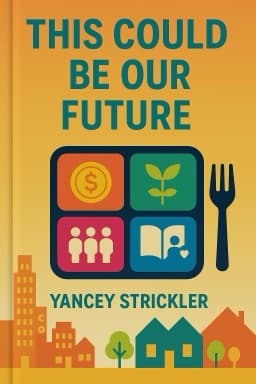
The book 'This Could Be Our Future' explores these themes deeply, inviting us to rethink rationality and embrace more generous social games that prioritize cooperation over competition. 1 3
Want to explore more insights from this book?
Read the full book summary