
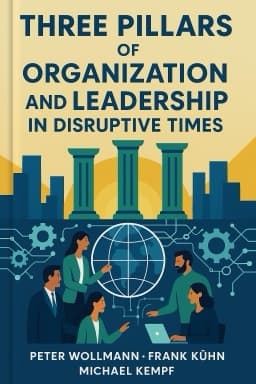
Unlocking Organizational Success: The Surprising Power of the Three Pillar Model
Discover how three foundational pillars can transform your organization in volatile times.

In today's fast-paced world, organizations face unprecedented challenges—disruption, uncertainty, and complexity. Traditional leadership and management approaches often falter under this pressure. Enter the Three Pillar Model: a revolutionary framework designed to guide organizations through turbulent times by focusing on three interlinked pillars—Sustainable Purpose, the Travelling Organization mindset, and Connectivity.
Sustainable Purpose acts as the organization's emotional compass. Unlike fleeting visions or short-term goals, purpose provides a stable, inspiring reason for being that resonates deeply with employees and stakeholders alike. This alignment fosters pride, motivation, and resilience. Imagine a lighthouse standing firm amid a storm, its beam cutting through the fog to guide ships safely home. Purpose is that beacon, grounding every decision and action.
Moving beyond purpose, the Travelling Organization embraces change as a constant journey rather than a series of discrete events. This mindset encourages agility, continuous learning, and experimentation. Organizations become explorers, adapting their course as new information emerges, much like a caravan navigating shifting landscapes. This approach replaces rigid hierarchies with dynamic, context-driven leadership where decision-making is iterative and decentralized.
The third pillar, Connectivity, is the invisible thread weaving people, processes, and strategies into a cohesive whole. It prevents fragmentation and silos by fostering trust, transparent communication, and collaboration. Connectivity balances diverse stakeholder interests and creates systemic resilience. Think of it as a complex web of glowing threads linking every part of the organization, enabling coordinated action and innovation.
Underlying these pillars are critical human factors: emotional intelligence, shared governance, and continuous learning. Emotional intelligence enables teams to build trust and navigate conflicts effectively. Shared governance distributes decision-making power, fostering collective ownership and transparency. Continuous learning transforms leadership development from isolated events into ongoing, team-based growth, ensuring organizations remain adaptive and connected.
Real-world examples reveal that organizations embracing this model experience higher employee engagement, reduced project failure rates, and enhanced innovation. For instance, IT projects with strong people connectivity show significantly better outcomes, underscoring the model's practical value.
In sum, the Three Pillar Model offers a holistic, human-centric approach to organizational leadership. It invites leaders to invest energy in meaningful purpose, embrace the journey of change, and nurture the connections that bind diverse talents and ideas. By doing so, organizations not only survive disruption but thrive and flourish in an ever-evolving future.
Ready to transform your organization? Embrace the Three Pillar Model and unlock the power of purpose, agility, and connectivity today.
Sources: Amazon overview of the book 1 , Magnolia Dolphin insights 2 , LinkedIn professional discussion 4
Want to explore more insights from this book?
Read the full book summary