
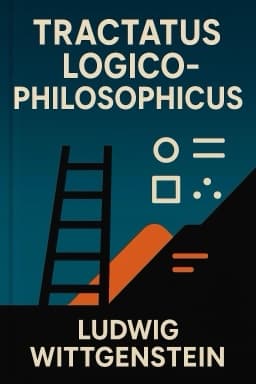
Unlocking the Mysteries of Wittgenstein’s Tractatus: The Philosophy That Changed How We See Reality
Dive into the profound insights of Wittgenstein’s groundbreaking work that reshaped modern philosophy and language theory.

Few philosophical texts have had as profound and lasting an impact as Ludwig Wittgenstein’s Tractatus Logico-Philosophicus. Written during the turmoil of World War I and published in 1921, this compact yet dense work seeks to map the relationship between language, thought, and the world itself. Its revolutionary claim is that the limits of our language are the limits of our world, and that what can be said must be said clearly, while what cannot be spoken of must be passed over in silence.
At the heart of the Tractatus lies the idea that the world is not a collection of things but a totality of facts — states of affairs formed by simple objects in specific relations. Wittgenstein challenges our intuition by asserting that objects themselves are the fundamental building blocks of reality, and facts are the ways these objects combine. This shift from 'things' to 'facts' reframes our understanding of existence, highlighting the primacy of relations and logical structure over mere material presence.
Language, Wittgenstein argues, functions as a picture of reality. Propositions are pictures that share the logical form of the facts they represent. This means that the meaningfulness of a statement depends on its ability to mirror the structure of the world. For example, the proposition 'The cat is on the mat' pictures a state of affairs where the objects 'cat' and 'mat' relate in a particular way. This picture theory of language elegantly explains how language can be true or false depending on whether it corresponds to reality.
Logic underpins this entire system. Wittgenstein shows that all propositions can be constructed as truth-functions of atomic propositions, with complex statements built from simpler ones through logical operations. The Sheffer stroke, a single logical connective, can define all others — revealing a surprising simplicity beneath the apparent complexity of logical relations. Tautologies and contradictions frame the boundaries of logical space, always true or always false respectively, yet neither representing facts themselves.
Yet language has limits. Wittgenstein famously states, 'Whereof one cannot speak, thereof one must be silent.' Many philosophical problems arise from misunderstanding these limits and attempting to express what lies beyond language’s reach. Philosophy’s task, then, is to clarify language and dissolve these nonsensical puzzles rather than to produce doctrines or theories.
One of the most profound insights concerns the metaphysical subject — the self. Wittgenstein posits that the self is not an object in the world but the boundary of the world, the limit of experience. This aligns with solipsism in a unique way: while the world is 'my world,' this fact cannot be expressed in language but only shown through experience.
Beyond the limits of language lies the mystical — truths and experiences that cannot be spoken but are deeply felt and shown. Ethics, too, resides in this mystical domain, transcending factual description and logical expression. Life and death, eternal life and meaning, all point to realities beyond words, inviting us to embrace silence and mystery.
Finally, Wittgenstein reveals that many philosophical problems are nonsensical, arising from language misuse. Philosophy acts as a therapeutic activity, clarifying thought and showing what can be said and what must remain silent. This approach has influenced not only philosophy but also linguistics, cognitive science, and even art.
Wittgenstein’s Tractatus remains a challenging but rewarding journey into the nature of language, thought, and reality. By understanding its insights, we gain new tools to navigate the complexities of meaning and existence, and a profound appreciation for the power and limits of human expression.
For those seeking to explore the foundations of philosophy and language, the Tractatus offers a timeless guide — one that continues to inspire and provoke thought a century after its creation.
Explore further readings and interpretations to deepen your understanding and engage with the ongoing dialogue around this seminal work.
References:
Want to explore more insights from this book?
Read the full book summary