
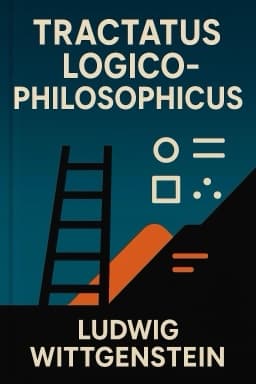
Why Wittgenstein’s Tractatus Is the Ultimate Guide to What You Can—and Can’t—Say
Discover the surprising rules that govern language and why silence might be the most profound response to life’s biggest questions.

Language is the tool we use to navigate the world, yet it comes with strict rules and boundaries that often go unnoticed. Wittgenstein’s Tractatus Logico-Philosophicus exposes these limits in a way that has reshaped philosophy and linguistics alike. The central message? There are things that can be said clearly—and things that must be left in silence.
At the core is the picture theory of language: propositions are pictures that share the logical form of the facts they represent. This means the meaningfulness of language depends on its ability to mirror reality’s structure. If a proposition does not share this form, it is nonsensical. This insight explains why some philosophical and metaphysical statements, though seemingly profound, fail to convey meaning—they attempt to say what can only be shown.
Logic plays a foundational role here. Wittgenstein demonstrates that all propositions can be constructed as truth-functions of atomic propositions, using logical connectives derived from a single operation. This elegant system reveals the deep simplicity underlying language’s complexity, and why tautologies and contradictions frame the boundaries of meaningful discourse.
But these boundaries carry profound implications. Wittgenstein famously concludes, 'Whereof one cannot speak, thereof one must be silent.' This is not a call to ignorance but a recognition of language’s limits. Many traditional philosophical problems arise because language is misused or stretched beyond its logical capacity, creating nonsense rather than meaningful statements.
The metaphysical subject—the self—is another boundary. It is not an object in the world but the limit of the world. Solipsism, often misunderstood, is here shown to be a true but unsayable insight: the world is 'my world,' but this cannot be expressed in language, only shown through experience.
Beyond language lies the mystical, including ethics and ultimate meaning, which cannot be captured in propositions but are deeply felt and shown. This mystical realm invites humility and silence, recognizing that some truths transcend words.
Wittgenstein’s Tractatus thus offers a powerful guide to the art of saying and the wisdom of silence. It dissolves philosophical confusion by clarifying language’s logic and boundaries, encouraging us to speak meaningfully and accept mystery where language ends.
For anyone fascinated by the philosophy of language, logic, or the limits of thought, the Tractatus remains a vital and illuminating text.
Explore more detailed analyses and interpretations to deepen your understanding.
References:
Want to explore more insights from this book?
Read the full book summary